-
Age Verification Is Coming For the Internet. We Built You a Resource Hub to Fight Back | EFF
…we’re launching EFF’s Age Verification Resource Hub (EFF.org/Age): a one-stop shop to understand what these laws actually do, what’s at stake, why EFF opposes all forms of age verification, how to protect yourself, and how to join the fight for a free, open, private, and yes—safe—internet. https://www.eff.org/deeplinks/2025/12/age-verification-coming-internet-we-built-you-resource-hub-fight-back
Fediverse reactions
-
January 15th: EFFecting Change: The Human Cost of Online Age Verification | EFF
Live stream panel session: Join EFF’s Rindala Alajaji and Alexis Hancock along with Hana Memon from Gen-Z for Change and Cynthia Conti-Cook from Collaborative Research Center for Resilience for a conversation about what we stand to lose as more and more governments push to age-gate the web. https://www.eff.org/event/effecting-change-human-cost-online-age-verification#main-content
-
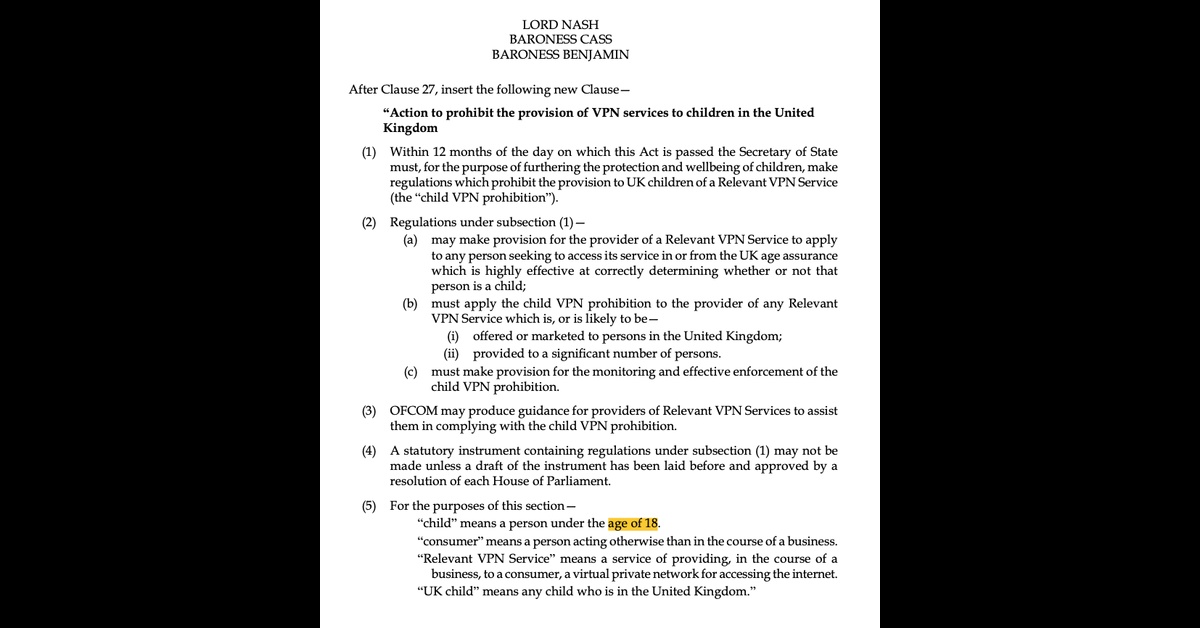
ERRATA: Baroness Benjamin et al. wish to ban children under the age of *18* from using VPNs; that’s better than 16, isn’t it?
This “child” is someone who will have been voting for 2 years. Possibly they will even be at university. https://bills.parliament.uk/publications/63901/documents/7465 page 19.
Fediverse reactions
-
Crowley: “For my money, the really big one will be all of Us against all of Them”
Below, me, in 2014/earlier, reflecting upon the perpetual war of intelligence agencies upon & against their citizens’ privacy. Elsewhere: Politico reports “How a new Russia-China-US network could work…” archived at https://archive.ph/IUvMS
-
AND FINALLY: UK House of Lords demands client-side scanning of content to check for “viewing of CSAM”
There’s a kind of Orwellian inevitability to this: “Action to promote the wellbeing of children by combating child sexual abuse material (CSAM) … (2) The “CSAM requirement” is that any relevant device supplied for use in the UK must have installed tamper-proof system software which is highly effective at preventing the recording, transmitting (by any…
Fediverse reactions
-
IT GETS WORSE: UK House of Lords attempting to ban use of VPNs by anyone under 16
This is deranged, each nation’s boomers and reactionaries attempting to outdo the others: “Action to prohibit the provision of VPN services to children in the United Kingdom” … the provider of any Relevant VPN Service which is, or is likely to be — (i) offered or marketed to persons in the United Kingdom; (ii) provided…
Fediverse reactions
-
BREAKING: UK House of Lords Draft Amendment to Ban Social Media for Under-16s in the UK
Baronesses Cass & Benjamin, and Lord Nash, propose to turn the UK into The Leather-Wrapped Village: “This new clause would require the Secretary of State to take action to promote children’s wellbeing in relation to their use of social media by […] introducing regulations to prevent under 16s from accessing social media.” The story goes: But…
Fediverse reactions
-
Open Rights Group: “Tell your MP to attend the debate on the Online Safety Act”
The Online Safety Act […] has enabled a wave of questionable age-assurance providers, restricted free expression by wrongly censoring lawful content, and made it harder for communities to run their own small websites … Parliament will debate this critical issue on 15th of December 2025. It’s time to make them understand what is at stake…
-
Two posts from 2014: Trolley Problems, Nuclear Weapons, Snowden, Jocks, and Meat-Grinders
These are a pair of Facebook posts from 2014 which I just want to transfer over to my blog for ease of finding; but if you are particularly interested in questions of utilitarianism and outcomes (having seen multiple references to “The Ones Who Walk Away from Omelas” in the past few weeks) they might be…
Fediverse reactions
-
The world needs social sovereignty | Mastodon Blog | Fediverse’s 800g Gorilla calls for local platforms, for local people…
Because of course what the world really needs is balkanized discourse policed by local law enforcement: “The term digital sovereignty means that an institution has autonomy and control over the critical digital infrastructure, data, and services that make up their online presence. Up until this point, social media has not been a part of this…