If someone is calling for human rights of the general populace to be undermined on the basis that “some of them might be doing something bad” — there is a very toxic precedent being followed.
At that point you’re less helping victims, more enabling oppression.
And then you dress it in an “…and companies” anti-corporate figleaf, to sweeten it:
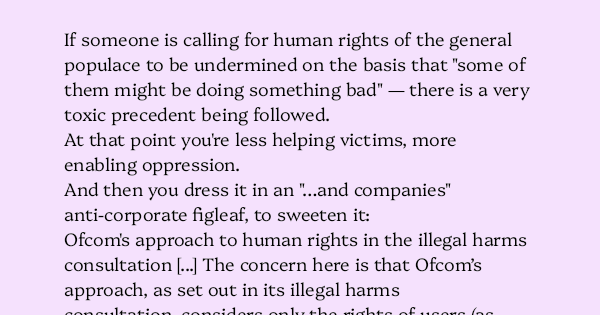
Ofcom’s approach to human rights in the illegal harms consultation
https://www.onlinesafetyact.net/analysis/ofcom-s-approach-to-human-rights-in-the-illegal-harms-consultation/
[…]
The concern here is that Ofcom’s approach, as set out in its illegal harms consultation, considers only the rights of users (as speakers) and has principally focused on their freedom of expression. In doing so, it has not really considered the nature of the speech (which the Convention court does take into account), nor provided evidence that speech in some instances would be chilled [^9] – it has rather hypothesised a rather theoretical concern. It has not considered the rights of other users and non-users that require steps to be taken against rights infringing harms – and where the infringement of a right has been recognised in the judgments of the European Court, or the opinion of UN Special Rapporteurs. This means that any balancing exercise is skewed towards not taking action for fear of inconveniencing users (who could well be infringing the rights of others) and companies.
Leave a Reply