[…]
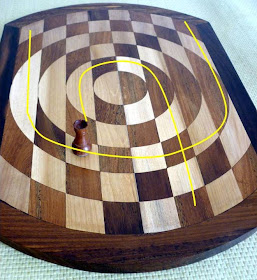
Since the board layout is a “curved space,” straight moves and diagonal moves have to be defined locally instead of globally. A straight move can be defined as a move which enters a “square” through one side, and may continue on to exit the “square” through the opposite (nonadjacent) side. A diagonal move can be defined as a move which enters a “square” through one corner, and may continue on to exit the “square” through the opposite (nonadjacent) corner.
This leads to some long-distance moves which are anything but straight as we think of straight. Notice how the rook’s move can take it looping around the center of the board, and right back like a boomerang to the same side of the board it started from.
la diagonale du fou: Singularity Chess
Comments
2 responses to “la diagonale du fou: Singularity Chess”
-
While the board’s topology isn’t changed by this transformation – in that the surface has neither gained nor lost any discontinuities – something rather fun has happened in the relationship between the formerly-squares. Out on the edge of the board, each nearly-square has the usual 8 neighbours – but when you look at the centre, each semicircle only has 6 neighbours. I’m therefore not entirely sure how a knight would traverse the centre of such a board…
-
I have been looking for one of these chess sets. Can not find where to buy one.Do you know who sells this type of board?
Leave a Reply