Why does #Twitter shorten links when a tweet is still less than 140 chars? #stopshortening

Why does unnecessarily shorten links via bit.ly (etc) when a tweet is still less than 140 chars?

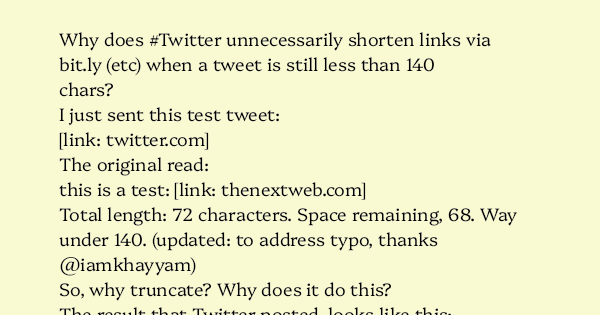
I just sent this test tweet:

http://twitter.com/alecmuffett/status/3684791756

The original read:

this is a test: http://thenextweb.com/2009/08/31/woman-fired-caps-email/

Total length: 72 characters. Space remaining, 68. Way under 140. (updated: to address typo, thanks @iamkhayyam)

So, why truncate? Why does it do this?

The result that Twitter posted, looks like this:

this is a test: http://bit.ly/qfMwY

My analysis:

  • Downsides: readers cannot see where the link goes, readers cannot obtain context (woman-fired-caps-email) from the URL string
  • Upsides: …none that I can see for the end user, in this situation; moreover since a submitted tweet must be shorter than 140 characters it’s not like this is a free service that enables extra tweeting; if I could submit a 163-character-tweet-including-a-URL and Twitter would auto-shorten it to less than 140 characters, then that would be good… but they don’t do that.

The only upside I can see is to drive traffic to bit.ly (etc) – and here comes the bad bit – DRIVE TRAFFIC TO bit.ly AT THE COST OF PROVIDING INFORMATION TO THE READER AND EXPUNGING CONTEXTUAL VALUE FROM THE ORIGINAL TWEET.

Doubtless bit.ly is doing analytics and that’s where the moneygrubbers are talking about “revenue streams” and so forth, but in the process TWITTER IS MESSING WITH MY TWEETS UNNECESSARILY.

Bandwidth is cheap. 140 characters is very cheap. 68 characters is not cheaper, it’s still less than $fragsize.

Please retweet using the tag “#stopshortening” – I wrote this posting, I picked the tag, I looked it up on Twitter Search and I found someone else came to the exact same conclusion. I’m satisfied it’s the right thing to do.

It’s time for Twitter to stop unnecessarily shortening URLs and removing context from my tweets.


Footnotes / FAQs:

Isn’t this the fault of the Twitter clients?

yes, partly; however the above experiment was done using the http://www.twitter.com web frontend, so it seems to be what Twitter themselves do; and if any organisation is in a position to suggest to API users that the above is bad behaviour, then Twitter itself, is.

Twitter automatically shorten links longer than 30 characters. Shorter ones are left untouched.

That does nothing to address the loss-of-context criticism, above; nor does it address “messing with my tweets”. Anyway, longer URLs are more likely to be like http://foo.com/you-can-work-out-what-the-thing-is-about-before-clicking-here.html, so isn’t that the reason for *not* shortening?


Shortening might have made sense when tweet-to-SMS gateways were still being used, but even then it should have been a *reader* option, not centrally enforced for all *writers*
Isn’t this done so that cellphone browsers can view tweets comfortably?

Yes; word-wrap is not an unsolvable issue, however; there are technologies and design rules which help with this sort of thing, plus there’s always something simple that can be done, like splitting the text into chunks but maintaining the hyperlink.
You’re trying to ban shortening?

No I’m not. I just want the option to switch it off.


Comments

23 responses to “Why does #Twitter shorten links when a tweet is still less than 140 chars? #stopshortening”

  1. I seem to remember reading in Twitter’s help somewhere that they automatically shorten links longer than 30 characters. Shorter ones are left untouched.

  2. Re: anyone saying “isn’t this the fault of the Twitter clients?”

    Answer: yes, partly; however the above experiment was done using the http://www.twitter.com web frontend, so it seems to be what Twitter themselves do; and if any organisation is in a position to suggest to API users that the above is bad behaviour, then Twitter itself, is.

    Thus why I think this needs to be addressed by Twitter themselves.

  3. Also, there may be a cutoff length, where URLs shorter than (say) N characters do not get run through bit.ly.

    However: that statement does nothing to address the loss of context criticism, above.

  4. @Diego: dude! Sorry, Wrote the above before I saw/approved your comment.

    Still… umm, so even if N==30, why do they do this nowadays when length < 140 ? Update: It might have made sense when tweet-to-SMS gateways were still being used, but then it should be a *reader* option, not centrally enforced.

  5. Yeah, the cutoff is 30 characters and it certainly makes viewing tweets easier on a small mobile screen …. come to think of it weren’t you complaining last year about tweets that were very long with no spaces as they couldn’t wrap!!?? :-p

    1. wrapping is required, yes, but that’s a browser issue.

  6. I think it’s an even better idea not to count URLs to the 140 chars at all, so that shortening is completely unnecessary.

  7. This has been bothering me for awhile as well – if they’re going to do this, then I should get to type in more context & not have the full length of the URL count against my 140 characters. I’ve deleted tweets and reposted them several times for the loss of context. annoying . 🙁

  8. Twitter isn’t a URL transmission service. Sure URL’s carry context, but I want some space to add my context. I want to be retweeted (needs 18 chars). Given that many people use TweetDeck which expands the URL for you or other clients like Spaz that convert them back, I’d rather see space saved in the tweet.

    The one drawback is that the URL if you don’t use a client that expands the URL, you can’t decide if its a trusted domain or not.

  9. There are so many reasons TO shorten a URL it seems silly not to. My main reasons are:

    1. Increases Retweetability. Space left for others to
    2. More space for comment or title.
    3. Improves scanability, less IS more.
    4. Blog URLs are incredibly long when they are SEOized and more usable for search engines than people.
    5. Few care what the URL is; they just want a call-to-action to click.
    6. It’s ubiquitous and expected.

    The only time I use the full URL is if I want to promote brand recognition of the domain.

    Now one future Twitter feature that would achieve all the benefits of shortened URLs and satisfy all those people dissatisfied with them is if Twitter simply swapped a long pasted-in URL with the domain followed by and ellipsis. They could also truncate links if they wanted an easier and more reliable script than the more complex bolean-based alternative.

  10. @Michael, Rob: Thanks for responding.

    First up: I want to make this clear: I do NOT want to BAN shortening services from Twitter, instead I want to make it *elective*, something that the sender chooses to do rather than has forced upon them.

    You know, like it used to be in the old days, when Twitter started out in 2006/2007?

    I guess I should add that to the FAQ.

    So: of course you *can* use shorteners but they should not be thrust upon you by either of clients *or* twitter itself.

    Second: there’s this cool advice from the W3C called “Cool URIs don’t change” – it’s at http://www.w3.org/Provider/Style/URI and the thing about shorteners is that they *do* change URLs – they replicate, and multiply them.

    By replicate, I mean they do the function of the original URL but without *being* the original; as an example of where this went disastrously wrong before, go look at what happened to the “Digg Bar” – people were sending around Digg-Bar URLs rather than real, original URLs, and everything got horrible.

    See http://broadcast.oreilly.com/2009/04/disabling-the-digg-bar.html – shorteners are like that, only slightly less-so.

    By multiply, I mean that for every URL on my blog, there is the original, then there is the version in tinyurl, bit.ly, ff.im, is.gd, tr.im, short.to and a whole pile of others; in truth this particular replication aspect doesn’t bother me *too* much but I wanted to mention it for completeness.

    However, there’s another aspect to the replication, in that it offers a SECOND point of failure, and quite a big one: if the shortener gets pulled off the net for whatever reason – eg: see tr.im history ( same URL: http://is.gd/2O24L ) – then that’s a BIG chunk of the historical record of Twitter that vanishes from the net and becomes useless.

    Imagine if Flickr just vanished from the face of the web and took your photos with it? It would be that sort of impact. Not good.

    I work on http://theMineProject.org/ and we actually are in *favour* of URL shorteners, but we would like everyone to be able to run their own so that loss of one has less of an impact upon the net as a whole.

    So let’s see: I think I have dealt with:

    * freedom to retweet (let the user/client choose to do it)

    * free space (ditto)

    * scanability/few care what the URL is (but some do/until they click on porn at work)

    * ubiquitous and expected (didn’t used to be, and if it’s expected then why are we arguing?)

    …then there comes to the SEO thing; personally I think SEO is evil and that Google is smarter than that, but if we’re looking at the Telegraph URL cited previously (and quietly, via link/href) in this comment:

    http://blogs.telegraph.co.uk/technology/basheerakhan/100002898/trims-resurrection-speaks-volumes-too-bad-its-all-trash-talk/

    …you’re right; it’s huge. Technically it’s not too bad if you read “Cool URIs don’t change” (section titled “So what should I do? Designing URIs”) – but it’s a pain to fit it in a tweet.

    So: shorten it. Fine, do that. By doing so you will provide mild evolutionary pressure on the Telegraph to give up SEO and shorten their URLs because as shortening-rot kicks in, sites that got shortened the most will lose traffic whereas sites with URLs less than 30 characters (or whatever) will retain some degree of “linky-love” from tweets, blogs and e-mails.

    Having short URLs could become a Web-Darwinian-survival-characteristic!

    Rob is right – Twitter is not a URL (HTML) transmission service, and in that I see it as being like (old) e-mail, and what happened to that?

    The issue is the 140 character limit. I don’t know how many people still receive tweets via SMS, but with the value of the API providing “retweet” and “in-response-to” URL-goodness, plus whatever other value which only comes at the REST API layer… Given all that I believe the SMS-ability of Twitter will soon be nil, everyone will use IM clients (I use Adium for Twitter) or custom phone clients (I use Twidroid) to read/write, and Twitter will just become another IM service of sorts, with an arbitrary (perhaps “artistic”?) limit on message length.

  11. […] take a look at http://www.crypticide.com/dropsafe/article/3403 – I would be interested to hear what you think in reply to Xlib […]

  12. I think I feel like we’re all running in circles here yelling at our calculator screaming, why OH why did you not show the complete calculation? Just because it was complex, convoluted & tirelessly long, we still should have been able to see each specific process that gave us our final result. Oh, shit, I’m being dramatic. 🙂

    URL Shortening, it’s not the beat. It’s not the end of the world. No conspiracy to control your linkage, dampen your SEO efforts or destroy the knowledge of humanity all in one click. It’s simply letting the info flow into a pipe as much as oil is the lube for your car and water is for our bodies.

    You can hate Twitter for it’s 140 character abomination. . But if you don’t understand that it was developed to flow effortlessly with existing mobile technologies to transmit our crafty little messages from one device to another, you’re missing the line that connects to that one historic DOT.

    In keeping with that same theme of passing information on from one device to another, long URLs are just a formality. All shortened URLs can be derived with 3rd party tools to show you where you’re going if you care about that sort of thing.

    If your concern is SEO, that’s exactly what a 301 redirect is for. It takes all that scary link juice and gushes it forth into a bucket on the other side of the originating domain, unhampered and not threatened… relax, SEO manipulation lives on.

    The reality is this: The average Joe neither has the time, the care or the knowledge to know how, why or where to shorten a URL. For Twitter to do this autoMAGICALLY saves us ALL a lot of time, speeds communication and YES it makes things VIRAL.

    I spend 10% of my time on Twitter shortening others links, words, phrases, tweets and ideas into nice little compartmentalized masterpieces that can then be transmitted to hundreds if not thousands of other people. Thank goodness that someone else is smart enough to make my job easier.

    Please, take the campaign against URL Shortening and step back and understand why it’s happening. No conspiracy. It’s to HELP YOU, not hurt you. 🙂

    Smile, tweet & let’s all be good moo moo’s 😀

    See, I’m mooing just fine, MOOOO!

    1. Hi Joel – I’ll be brief.

      I like Twitter

      I like the 140 character limit, it is slightly arty, and encourages brevity

      I like URL shorteners, in fact I will soon be running my own for personal use

      I think it makes no sense to shorten URLs when a message is already less than 140 characters, regardless of the length of the URLs themselves

      I think the philosophy of SEO (“Let’s try to game the search engines”) is misguided, but that’s not at issue here

      I disapprove of making everyone suffer something because of a presumption of what an “Average Joe” can/can’t cope with

      (10 years ago, the “Average Joe” was assumed barely able cope with a browser)

      I have three requests:

      1) Stick the shortening in the client where it belongs, remove it from the server-side

      2) Make it optional for the user to use

      3) Encourage the above in the Twitter API documentation

      Is that unreasonable?

      Oh, and please stop trying to paint me as a conspiracy nut. Thanks.

  13. Just as a quick note, that was freestyle, unedited. Lots of errors, grammatical, spelling. 🙂 Deal. LOL

  14. Just a little tombstone here: I deleted a pile of stuff from this comment thread, stuff which I feel was more personally-directed and trollish than actual discussion.

    I’ve archived it. Anyone wants a copy, drop me a line.

  15. alecm

    yet another link with technical discussion:

    http://joshua.schachter.org/2009/04/on-url-shorteners.html

  16. xxxx

    I agree. When I post a link to a youtube video, I would like to people to see that it’s youtube before they click so it’s obvious that it’s a video.

Leave a Reply

Your email address will not be published. Required fields are marked *