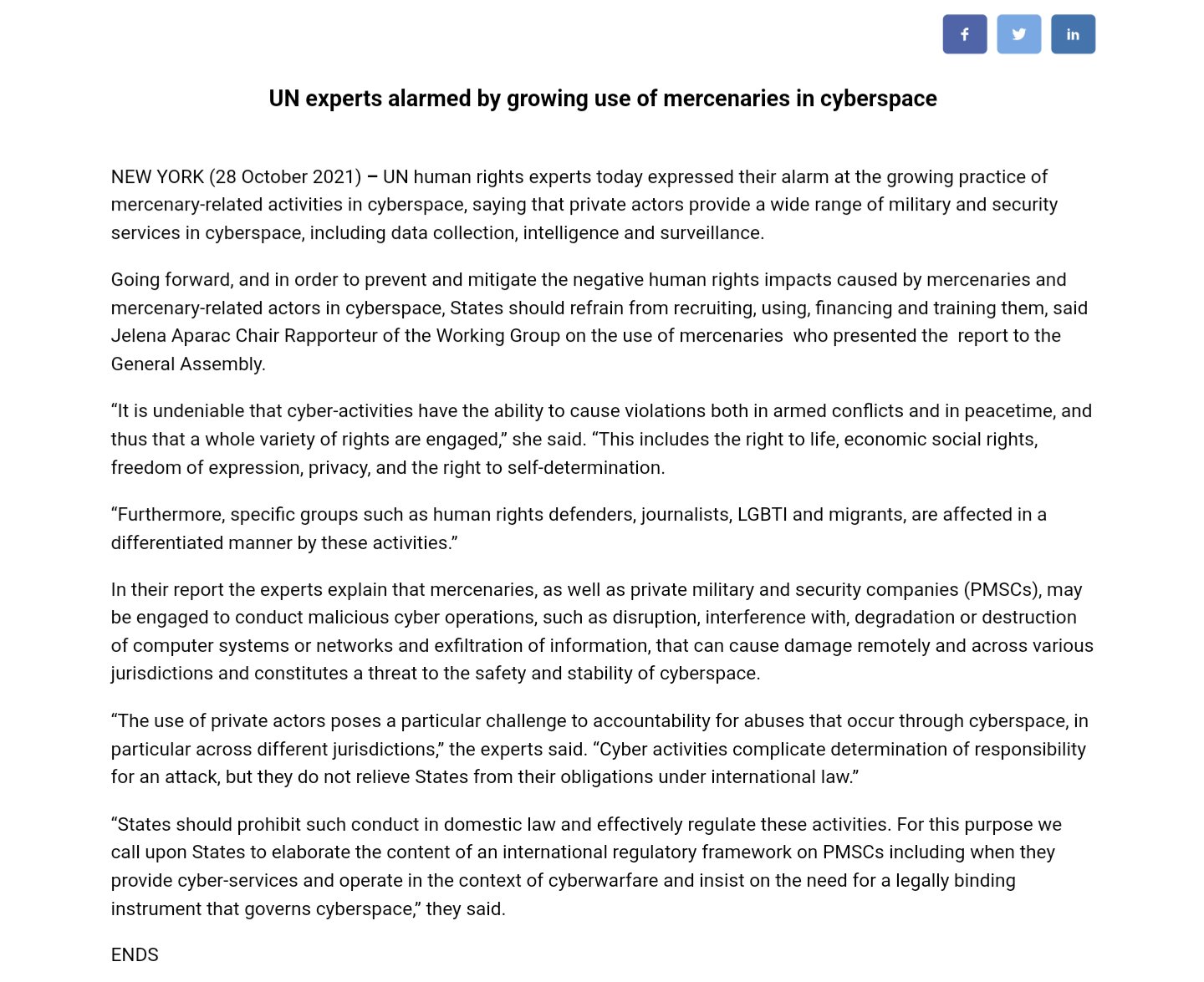
Runa: Good point from @UN human rights experts on the use of mercenaries in cyberspace: “The use of private actors poses a particular challenge to accountability for abuses that occur through cyberspace, in particular across different jurisdictions.”
https://www.ohchr.org/SP/NewsEvents/Pages/DisplayNews.aspx?NewsID=27729&LangID=E
Alec: White Hat Hackers: “Do they mean [me]?”
R: No.
A: Hard disagree. The fallacy of cyber is that states are the only people who hack other systems in any interesting way. #Cyberwar is a nonsense; cyber mercenaries doubly so; the attached propagates the “tail wags the dog” approach to “cyber”, harming public understanding overall.
R: So, I agree with your points here and I also think the quote from the UN is a good one.
A: Help me understand the “good” that you see?
R: I think it’s fair to say (and so a good point to make) that states haven’t figured out “what to do” about stuff that happens in cyberspace, be it by another state or a private actor. Lots of options, inc. sanctions and such, but not much informed debate so far. So, yes, it does pose a particular challenge and the solution to it must also address the point you raised.
A: Not to put too fine a point on it, this is exemplified in something like the “Snow Crash” dystopia, or in “sovereign identity” people (however rabid) who do at least have 1 point:
That point is: in a domain of speech like the Internet, shorn of physical military objectives like “high ground to hold & defend”, the “sovereignty” of nation states is matched by those of corporations or of sufficiently capable individuals.
Nation states don’t even hold a cybermonopoly on “kinetic” consequences (in the cyber terms of e.g. “switching off water supplies”) which breaks the traditional “monopoly on force” model of Government.
As such: any frame that still holds states as “special” except amongst themselves, is in severe need of exceptional justification.
One nation’s Cybermercinaries are another’s Ethical Hackers.
R: I completely agree.
A: And lo, somehow we started [towards this argument]
R: Yep, hence my comment later saying there hasn’t been much informed debate and your point is very valid. Do they mean you? Maybe. Should they? No.
off-thread, see also: Marcus Ranum

Leave a Reply