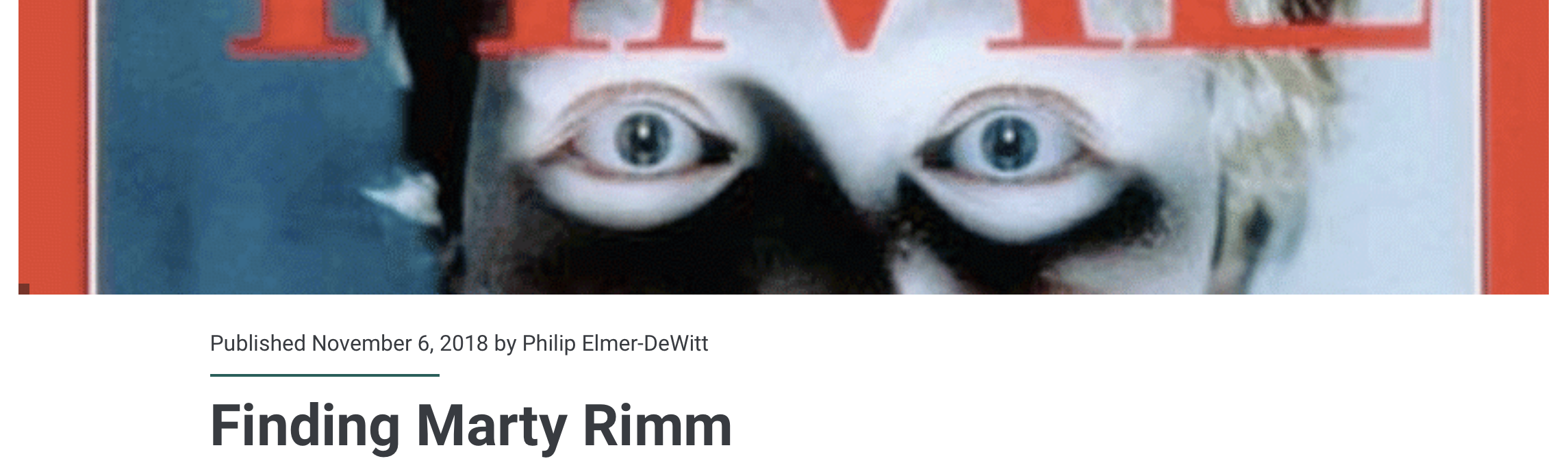
I was dimly aware of this event – from 1992-96 I was splitting my time between work, commuting to-and-from-work, a then-relationship, and attempting to popularise encryption, in roughly that order of priority – but I do remember seeing the “Cyberporn” cover story on TIME magazine and thinking that it was (a) likely ill-informed, and (b) going to cause trouble.
From the vantage point of the UK, I didn’t really see the extent of the trouble that it would cause:
Last year, as an undergraduate studying electrical and computer engineering at Carnegie-Mellon University in Pittsburgh, Mr. Rimm wrote a research paper called “Marketing Pornography on the Information Superhighway.”
NYTimes: TECH: ON THE NET; The Internet battles a much-disputed study on selling pornography on line.
As undergraduate papers go, this was a rip-snorter. It was ambitious and clever and based on a controversial and topical issue. It was 85 pages long and laden with footnotes, and had an eye-popping subtitle: “A Survey of 917,410 Images, Descriptions, Short Stories, and Animations Downloaded 8.5 Million Times by Consumers in Over 2,000 Cities in 40 Countries, Provinces and Territories.”
It had the kind of flaws one might expect in an undergraduate paper: sloppy writing, misleading analysis, ambiguous definitions and unsupported conclusions. With some good faculty guidance and judicious editing, it might have become the basis for an important graduate thesis.
The trouble is, Mr. Rimm’s student paper wound up in the Georgetown Law Journal.
The NYTimes piece is a contemporary summary and (if you can get at it) it includes an illuminating and frequent opening gambit – the conflation of “all pornography” with what we now more precisely refer to as “child {exploitation or abuse} imagery” in pursuit of moral or political advantage:
“I’m astonished that the focus of the study has become Marty Rimm rather than pornography in cyberspace,” [Rimm] said. “I’m astonished that those who acquired the data are being attacked rather than those who peddle child pornography.”
Marty Rimm, in NYTimes q.v.
25 years later…
What the NYTimes report lacks is a long view; for that I would recommend some more resources, of varying provenance but worthy content:
- Cry Wolf: Time Magazine and the Cyberporn Story (PDF)
- Misunderstanding Cyberculture: Martin Rimm and the ‘Cyberporn’ Study
- “Cyberporn” Turns 20
- Finding Marty Rimm
The latter is particularly interesting, as it’s a retrospective by Philip Elmer-DeWitt, the author of the TIME piece, who was so attacked for his work that:
I spent the rest of the summer of ’95 in a defensive crouch, feeling like the most hated man on the Internet. My stories got slammed. My words got turned against me. A denial of service attack hit my e-mail account with so much spam it crashed my Internet provider’s servers. I stopped writing, left the tech beat, and spent 12 years as the magazine’s science editor before retiring to do what I do now: Write a blog for Fortune about Apple Inc.
https://www.ped30.com/2018/11/06/cyberporn-marty-rimm/
The process? Bad. The data? Also bad, and perhaps dubiously sourced. The undergraduate author of the “research” paper? He changed his name and apparently dropped out of society. The most illiberal bits of laws that were rammed onto the books because of the horrors described in TIME? Had to go up to the US Supreme Court to be struck down. There’s a lot to unpack, and the resources that I’ve listed above, are a great start, and far better and more detailed than what I could add to the discussion.
But are the lessons of that experience still relevant, today?
- The Open Letter from the Governments of US, UK, and Australia to Facebook is An All-Out Attack on Encryption
- Orders from the Top: The EU’s Timetable for Dismantling End-to-End Encryption
- End-to-end encryption ‘puts children at greater risk of exploitation’
- Visa and Mastercard are Trying to Dictate What You Can Watch on Pornhub
- Pornhub Upended the Porn Industry. Now New Changes Could Destroy Sex Workers’ Livelihoods
Yes, I would say so; in fact, this very month, more than ever.

Leave a Reply