Over the past few years I’ve enjoyed Mark Rober’s series of glitterbomb parcel-theft videos, and the latest episode landed a few days ago, and it’s a delightful watch:
One of the things which I really appreciate is that in the latter two videos Mark has gone out of his way to dispel the “negatives” around parcel theft – he takes time to point out that it’s something like only 3% of cases where something bad happens, and that the vast majority of people are good, even helpful, some even going out of their way or doing research in order to prevent an unfortunate “theft”.
This is something that my broad community – information security, network security, “cyber”, whatever you want to call it – typically does not do; it is in nobody’s commercial, political or regulatory interest to say that “yes, bad stuff happens online, but maybe we should also consider the vast majority of good stuff that happens and which is enabled by all these improvements in technology, privacy, and integrity”.
Our discipline is mired by people talking in absolutes – even dreadful absolutes – and the math simply doesn’t stack up; we even selectively conflate the bad impacts of the technology, with arguments that look something like:
Given a population of 100 people, if 6 of them are potential terrorists and this technology allows them to communicate privately amongst themselves and to “groom” other people, then that’s 36 potential terrorist groups (36%) that the security services have to monitor – PLUS all of the outbound communications from those six; this is expensive and complex, and we need {help, money, new laws, back doors in encryption}
AB, AC, AD, AE, AF, BC, … ABC, ABD, ABE, … ABCD, ABCE …
The people who make these arguments are appealing to Metcalfe’s Law which says that the value or impact of a network increases as the square of its membership – but somehow they forget to also apply Metcalfe’s Law to the outer set:
100 ^ 2 = 10,00036 / 10,000 as percentage = 0.36%
…so the overall impact of those 6 people upon the community is not 36%, but actually a tiny 0.36% in these totally artificial but illustrative circumstances.
The positive effects of enormous networks of “mostly good” people, empowered by communication, grow to utterly dominate the impact of bad people – however those positive effects tend to be ignored because they are considered mundane, boring, or even anathematic to some other goals (“kids spend too much time playing online games” – I wonder how many kids have been teaching Zoom skills to their parents, this past year?)
Some people argue against freer and more secure communication, because of the potential for abuse; when confronted with the above they take refuge in absolutism: “if only a single person is saved from harm by the collective sacrifice of strong privacy for everyone, then it will be worthwhile” – and although that’s a very noble sentiment, it ignores the interests or choices of individuals, and also the history of the insurance industry suggests that it is not true. Also: Metcalfe’s law requires that the sum of the actual harm needs to be weighed against the sum of the squares of the potential “goods”, and we’re back in the land of “the good vastly dominating the bad”.
I am a humanist and an unreconstructed tech optimist, and I believe that most people are good, and that as such “goodness-squared” is the rule of the world. It’s hard to convince people, because “what bleeds, leads” and because the darkness is much more enticing, and it “sells”. Darkness garners more clicks, fear sells more product, threat justifies more budget, more controls, and more power.
But the good is out there, and when discussing the bad we should never forget that, nor underplay its significance. As the end of every episode of BBC Crimewatch also used to say:
See also: https://www.bbc.co.uk/news/av/entertainment-arts-41653128
Postscript: Crimewatch
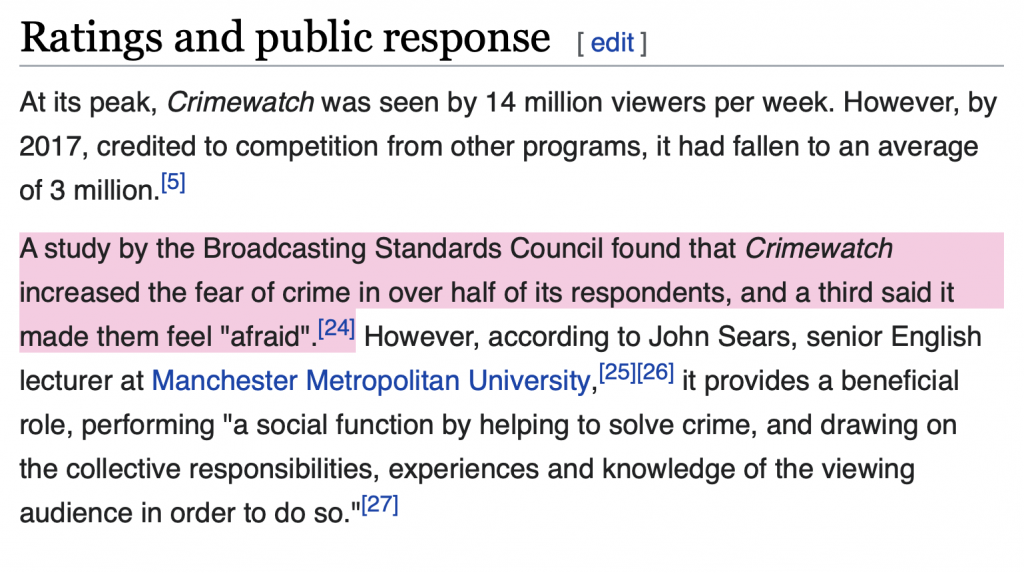
The BBC TV Program from which the above, famous clip was taken, was itself accused of increasing the “fear of crime”, and frankly I would agree with that assessment, and moreso of the similar popular TV shows, and even of the “True Crime” podcasts which have grown in its wake. Perhaps by some form of target fixation, even when telling people “Don’t Have Nightmares”, they still primarily remember and fear the badness because it is not bracketed with “goodness-squared”?

Leave a Reply