Rein-in Your Wordy Weirdness, By [Deity]!

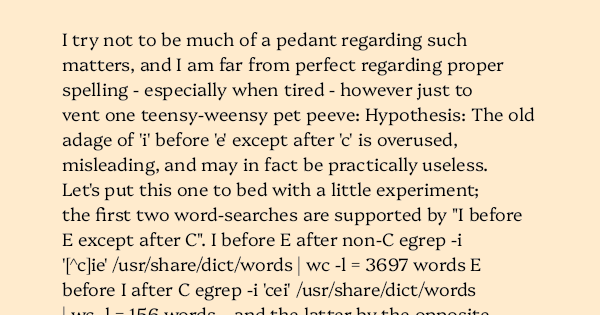
I try not to be much of a pedant regarding such matters, and I am far from perfect regarding proper spelling – especially when tired – however just to vent one teensy-weensy pet peeve:

Hypothesis: The old adage of ‘i’ before ‘e’ except after ‘c’ is overused, misleading, and may in fact be practically useless.

Let’s put this one to bed with a little experiment; the first two word-searches are supported by “I before E except after C”.

  • I before E after non-C
    egrep -i ‘[^c]ie’ /usr/share/dict/words | wc -l = 3697 words

  • E before I after C
    egrep -i ‘cei’ /usr/share/dict/words | wc -l = 156 words

…and the latter by the opposite of the above adage:

  • E before I after non-C
    egrep -i ‘[^c]ei’ /usr/share/dict/words | wc -l = 2447 words

  • I before E after C
    egrep -i ‘cie’ /usr/share/dict/words | wc -l = 257 words
  • The respective pairs of numbers are of the same magnitude; if it were significant to do the maths then we could argue that 51% more words (3700ish) are in favour of the adage than against it (2450ish) – but were I were a betting man, I would not like those odds.

    Three-to-two in favour smells like a hung verdict to me.

    Amongst the words which go against the rule and I often encounter misspelled, are:

    • deign
    • deity
    • heiress
    • heirloom
    • seize
    • vein – people give up on this one and just misuse vain, but worst of all comes:
    • weird

    Why do so many people have problems with “weird”? Strangely I rarely encounter being or feisty, height or (pointedly) weight misspelled. “Weird” is only a stone’s throw away from the latter.

    For those who want to nitpick, the provenance of the dictionary in this experiment is the MacOS X v10.3.9 wordlist, which comes with the following note:

    Welcome to web2 (Webster’s Second International) all 234,936 words worth. The 1934 copyright has elapsed, according to the supplier. […] The wordlist makes a dandy ‘grep’ victim.

    …so it’s an old Webster which I therefore believe is adequate for the needs of this posting.

    Anyway – I’m off to bed. Enjoy. HTH. HAND.
    Comments

    14 responses to “Rein-in Your Wordy Weirdness, By [Deity]!”

    1. Chris Walsh
      re: Rein-in Your Wordy Weirdness, By [Deity]!

      As I learned it (or, if you like, “learnt it”), there was a second half to the rule: “or when sounded like ‘A’, as in ‘neighbor’ or ‘weigh’”. “Weird”, accordingly, is.

    2. alecm
      re: Rein-in Your Wordy Weirdness, By [Deity]!

      I must admit I’d have a problem squeezing an “ay”, “ah”, or “aw” sounds into (specifically) “weird”, and “seize”, but you’re bang-on with “weight” and “deity” , I’ll agree.

      If course I now have to wonder about an “-cie-” counter-example – alas words like “species” seem immune to error, presumably because “-cies” and “-cient” (etc) are so common. The only ones I see get goofed (born in PA, I am allowed to say that) are the “conscience” variants, presumably because they sound to some like they ought to be spelled “con-shunse”, leaving you free to guess in what order the vowels should written.

    3. alecm
      pittsburghese

      In explanation of “get goofed” in the above comment:

      http http://www.pittsburghese.com/voa/voa-final.mp3

      “Jaggers” and “gumbands”… my my that was a long time ago.

    4. Weez
      re: pittsburghese

      No, you’re wrong, it’s “gumbanz”

    5. Gene
      re: Rein-in Your Wordy Weirdness, By [Deity]!

      Alec:

      I’d like to see the egrep syntax for part 2 of The Rule, namely “or when it sounds like A as in neighbor and weigh”

      Shall I hold my breath?

      -Gene

    6. alecm
      re: pittsburghese

      oops, yes, you’re perfectly right sis; flipping through the list of nouns was an odd experience; I remember “stair-step” and a few others, though a lot of it was too adult focused for my experience and memory…

    7. Stephen Usher
      re: Rein-in Your Wordy Weirdness, By [Deity]!

      I believe the “rule” is really:-

      ‘i’ before ‘e’ except after ‘c’ but only when the word isn’t derived from Latin or Saxon.

      The problem is that English is such a mongrel language that no one set of rules works with all words, only really sub-sets which came from the same original source language.

    8. alecm
      re: Rein-in Your Wordy Weirdness, By [Deity]!

      Got an Oracle license so I can use SOUNDEX ? 😎

    9. alecm
      latin and saxon

      No latin, no saxon; I suppose that rules out french, high and low german, large chunks of welsh… lots of stuff…

      Doesn’t that just leave the stuff we’ve stolen from Greek, Hindi and Turkic languages? 😎

    10. Chris Walsh
      re: Rein-in Your Wordy Weirdness, By [Deity]!

      Alec:

      Windows grep can (purportedly) use soundex :^)

    11. Mozza
      re: Rein-in Your Wordy Weirdness, By [Deity]!

      I seem to recall being taught “I before E except after C *when the sound is eee* ” with a little ditty of “Weird Sheila seized (something I’ve forgotten) by the weir” as being the notable exceptions.

      My own pet hate of late is the organisiation I work for and its completely mangled phrases and made up words, crowned by the <rammed down our throats> tautology… “Working together in partnership”. Could drive a person quite mad, I tell you. <G>

    12. Mozza
      re: Rein-in Your Wordy Weirdness, By [Deity]!

      or *organisation* I work for, even. <blush>

    13. alecm
      re: Rein-in Your Wordy Weirdness, By [Deity]!

      not “the organisation for which you work”, then? 😎

    14. Mozza
      re: Rein-in Your Wordy Weirdness, By [Deity]!

      Giving up, I am.. back to the swamps.

      I shouldn’t be saying anything unless it starts with “I was proceeding in a Northerly Direction” and ends with “Yerroner!” I get in much less trouble that way. <VBEG>

    Leave a Reply

    Your email address will not be published. Required fields are marked *