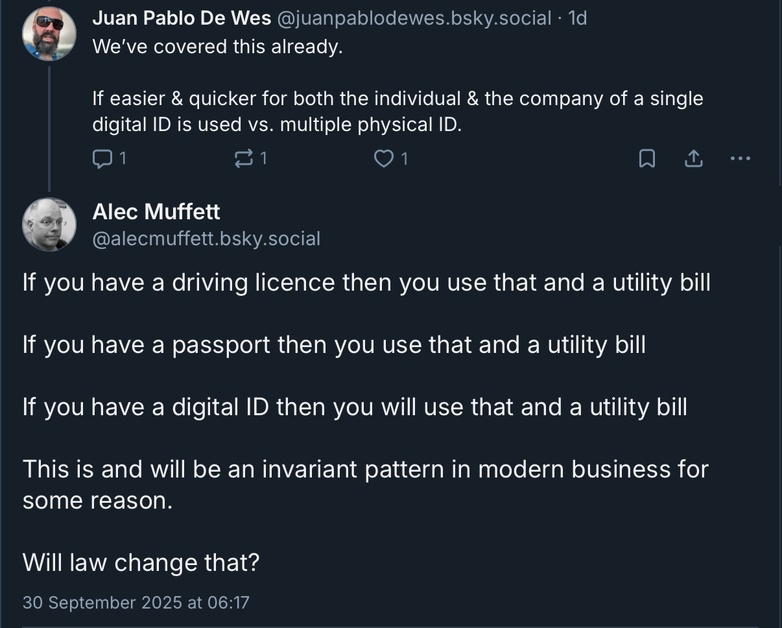
I spent the best part of 14 hours yesterday learning how to argue with people who, perhaps blindly, believe that Digital ID will bring “advantages” to “everybody”; a detailed example was “renting a car” which demands both an identity document and an independent proof of recent address, such as a utility bill.
I was told that this inconvenience will go away:
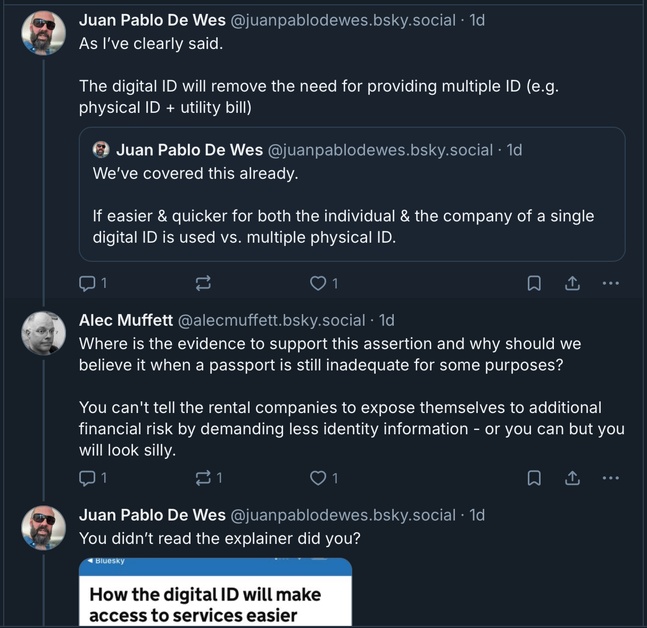
…aaaaand the proof as an assertion on a Government website.
Since I have worked in this industry for 40 years, including for companies where payment processing, chargebacks and fraud were core business issues, I believe that this assertion — at least as a proposal from the Government, you know, the people who write compliance requirements? — leaves unstated a core business risk issue.
If someone is renting a car, getting a mortgage, or something like that, you need to know where they live in order to go get it-or-them if something goes wrong. You gather multiple items of documentation to corroborate the information that the user has supplied.
You want them to jump through hoops, that’s the whole point of the checks: to determine for yourself as the {car, mortgage, banking, …} provider, whether the customer is pukka. Each hoop lowers your risk, and therefore lowers your costs.
The Digital ID Card schtick is that all this will be done away with; okay, let’s imagine that the Government has the power to do that — the power to say IF SOMEONE PRESENTS A DIGITAL ID CARD THOU SHALT STOP ASKING ANY FURTHER QUESTIONS — which is not a power that they currently have. Let’s imagine that they do that, in which circumstance fewer hoops are jumped-through, more risk is forcibly accepted, more fraud occurs and higher business costs result.
Who will it be, underwriting that risk?
The Home Office? No, I very much doubt that.
The costs will be borne by UK businesses, who will therefore return to demanding extra bits of ID documentation, and *poof* the single greatest advertised advantage of the Digital ID card will vanish.
The Government may respond by embedding even more information into the ID card, see emphasis:
The new digital ID will be the authoritative proof of who someone is and their residency status in this country. It will therefore include name, date of birth, information on nationality or residency status, and a photo – as the basis for biometric security – just like an eVisa or Passport. The consultation will consider whether including additional information, like address, would be helpful.
…but that will create extra cost for the ID Card programme and obligations on people to keep that information up to date; given how many driving licenses are out of date with respect to contact information, this could be a considerable overhead for a much larger ID Card programme.
If we accept that multiple forms of ID will continue to be a business requirement in spite of what the Government says, then the value of the Digital ID card drops to being yet another identity document:
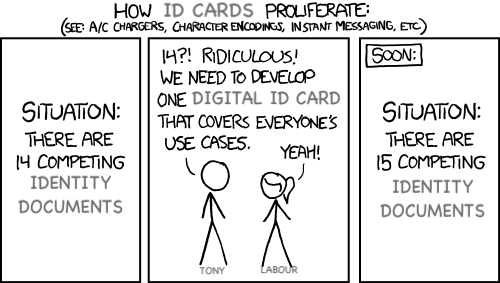
…and we will still be stuck using them on multiple occasions, and many of the use-cases carry their own task-specific identity document: passports for travel, driving licenses for cars…

Leave a Reply