I keep being asked or seeing people asking “what is the UK problem with having ID cards? We in Europe have ID cards and it’s fine!” — so I thought I would answer this question from my perspective, once and for all.
The answer is: Britons (mostly) have a kind of self-knowledge.
There are two types of Briton for us to consider:
- The contingent of Britons who are petty, small-minded, ungenerous curtain-twitching sado-masochistic misers who believe that “the country is full enough already” and who welcome any opportunity to say “no” and/or to control the activities of other people, mostly because they feel so insecure, unempowered, and generally ineffectual ever since losing the British empire and concomitant opportunities to colonialise and victimise other cultures. They especially love gatekeeping and various forms of bureaucratic process in order to exclude people rather than to attempt to solve complicated social problems.
- The contingent of Britons who actually believe in the shit that politicians used occasionally to spout, painting the country as a pastoral land of liberal, democratic, caring and generous people. The kind of people who banned slavery and fought for women’s votes and who built infrastructure ostensibly to assist the poor, weak and disenfranchised, rather than to make more of them.
These categories are timeless, and some of our greatest writers even wrote about this cultural underbelly of the British psyche.
Unfortunately the first category are “on the up” at the moment — witness Brexit, witness the phenomenal amounts of media attention, hatred, and uneconomic amounts of political time and money being thrown at suppressing rather than addressing or even integrating a few thousands of people crossing the channel from France in “small boats”.
Giving British racists more tools – e.g. an ID card to demand (on an unlocked phone device) when they wander around in petty little lynch mobs, would be a really bad idea. Scroll sideways to experience bigotry:
…especially with the prospect of a far-right Government coming into some form of power in the country.
When Brexit happened there I saw my international colleagues arrive at the office in London having been shouted-at to “go back home”. This is not good, and installing an ID card — now especially, but at any time generally — would be adding fuel to the fire of “foreigners are the problem, we are the victims” xenophobia in the country.
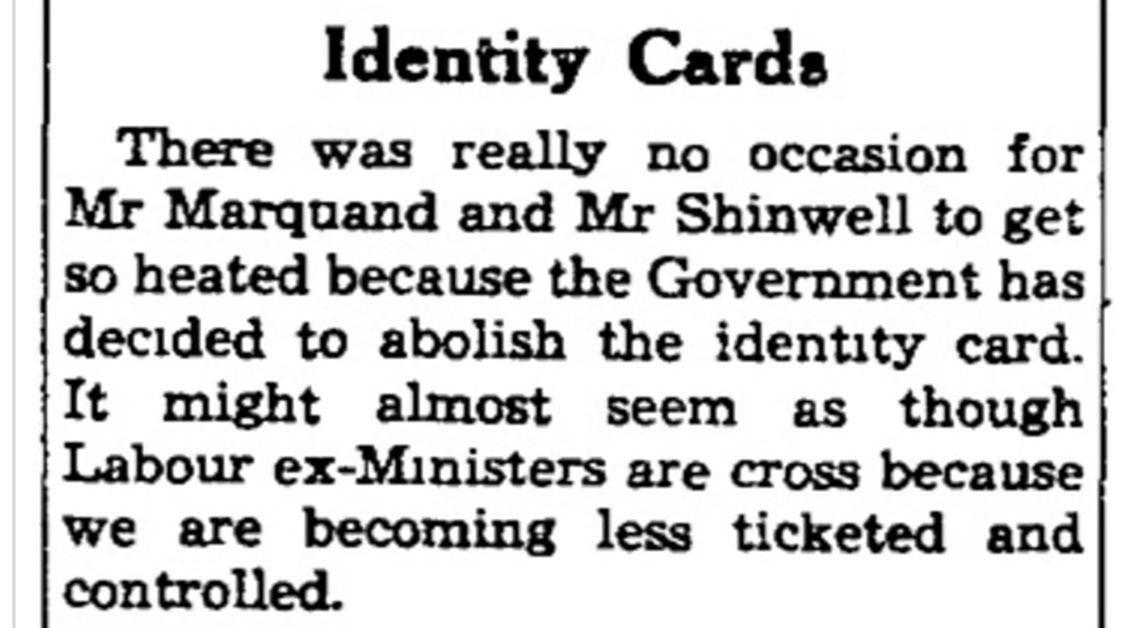
It’s telling that ID cards were only created in the UK in response to World War 2, and they lingered for several years afterwards until a citizen was stopped by the police and arrested for not presenting one, even though the threat of wartime spies was long past. It required that citizen to prosecute the illiberal nature of the obligation to present papers, before ID cards were abolished:
By the early 1950s, the identity card had become a routine part of policing. In 1950, a young man, Clarence Willcock, was stopped in his car by a policeman in North London on suspicion of speeding and asked for his identity card. Like the good Young Liberal that he was, Willcock refused to produce his card. Willcock’s argument to the Middlesex magistrates was that the National Register was a piece of wartime legislation that was no longer in force in peacetime. The magistrates disagreed. The Appeal Court not only confirmed the judgement but also gave Willcock an absolute discharge and in his concluding remarks, Lord Goddard, the Lord Chief Justice and soon to be infamous as the hanging judge in Derek Bentley case, strongly criticised the police’s use of identity cards:
It is obvious that the police now, as a matter of routine, demand the production of national registration identity cards whenever they stop or interrogate a motorist for whatever cause. Of course, if they are looking for a stolen car or have reason to believe that a particular motorist is engaged in committing a crime, that is one thing, but to demand a national registration identity card from all and sundry … , for instance, from a lady who may leave her car outside a shop longer than she should, or some trivial matter of that sort,…is wholly unreasonable.
This Act was passed for security purposes, and not for the purposes for which, apparently, it is now sought to be used. To use Acts of Parliament, passed for particular purposes during war, in times when the war is past, except that technically a state of war exists, tends to turn law-abiding subjects into lawbreakers, which is a most undesirable state of affairs. Further, in this country we have always prided ourselves on the good feeling that exists between the police and the public and such action tends to make the people resentful of the acts of the police and inclines them to obstruct the police instead of to assist them.
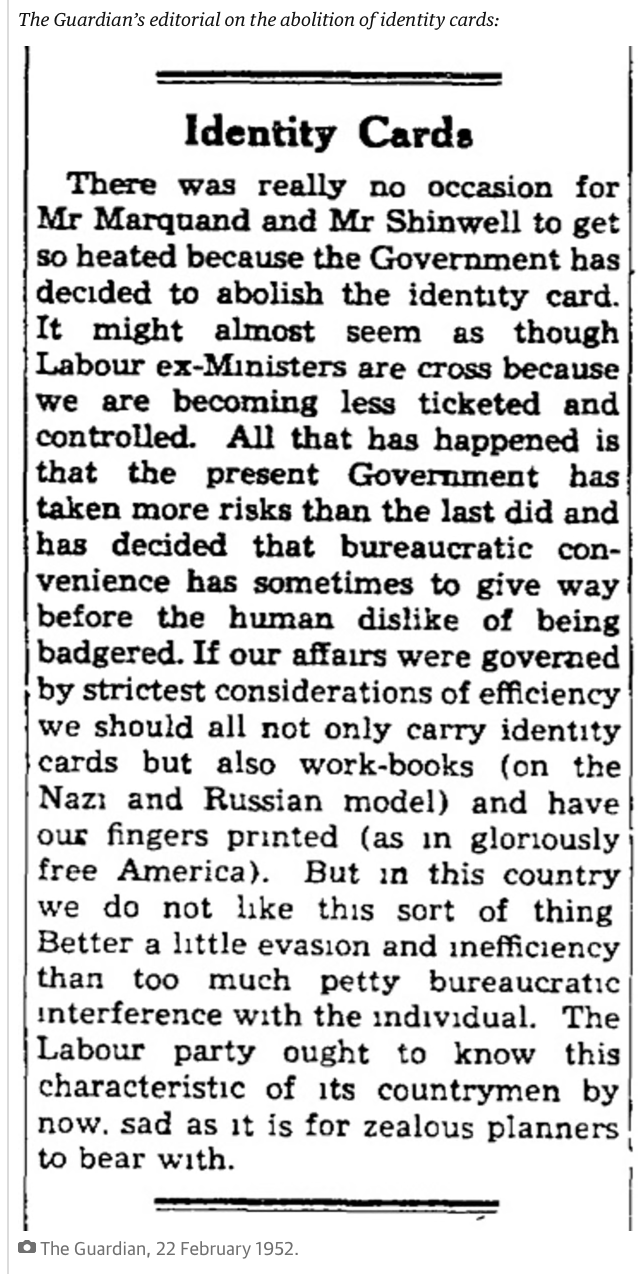
Perhaps unsurprisingly, Labour were opposed:
https://www.theguardian.com/politics/2018/feb/22/identity-id-cards-abolished-1952
…and it could be argued that they’ve been trying to get them back ever since, because love them or hate them, the one thing that the left are very good at is attempting to hoard and centrally disburse resources.
Summary
Why do we not want ID cards?
Because some of us are terrible people, and we know it.
References
If you want more on UK ID cards and past attempts to resurrect them, check out:
- https://historyandpolicy.org/policy-papers/papers/identity-cards-in-britain-past-experience-and-policy-implications/
- https://www.bbc.co.uk/news/10164331
- https://en.wikipedia.org/wiki/NO2ID
Obligatory Terry Pratchett Quote
From Night Watch; wannabe hero of the revolution Reg Shoe attempting centralised control of otherwise abundant resources in order to ensure “fairness”:
‘On behalf of the Republic I order you-‘ Reg began, and Vimes put his hand on his shoulder.
‘Off you go, sergeant,’ he said, nodding to Dickins. ‘A word in your ear, Reg?’
‘Is this a military coop?’ said Reg uncertainly, holding his clipboard.
‘No, it’s just that we’re under siege here, Reg. This is not the time. Let Sergeant Dickins sort it out. He’s a fair man, he just doesn’t like clipboards.’
‘But supposing people get left out?’ said Reg.
‘There’s enough for everyone to eat themselves sick, Reg.’
Reg Shoe looked uncertain and disappointed, as though this prospect was less pleasing than carefully rationed scarcity.
‘But I’ll tell you what,’ said Vimes. ‘If this goes on, the city will see to it the deliveries come in by other gates. We’ll be hungry then. That’s when we’ll need your organizational skills.’
‘You mean we’ll be in a famine situation?’ said Reg, the light of hope in his eyes.
‘If we aren’t, Reg, I’in sure you could organize one,’ said Vimes […].

Leave a Reply