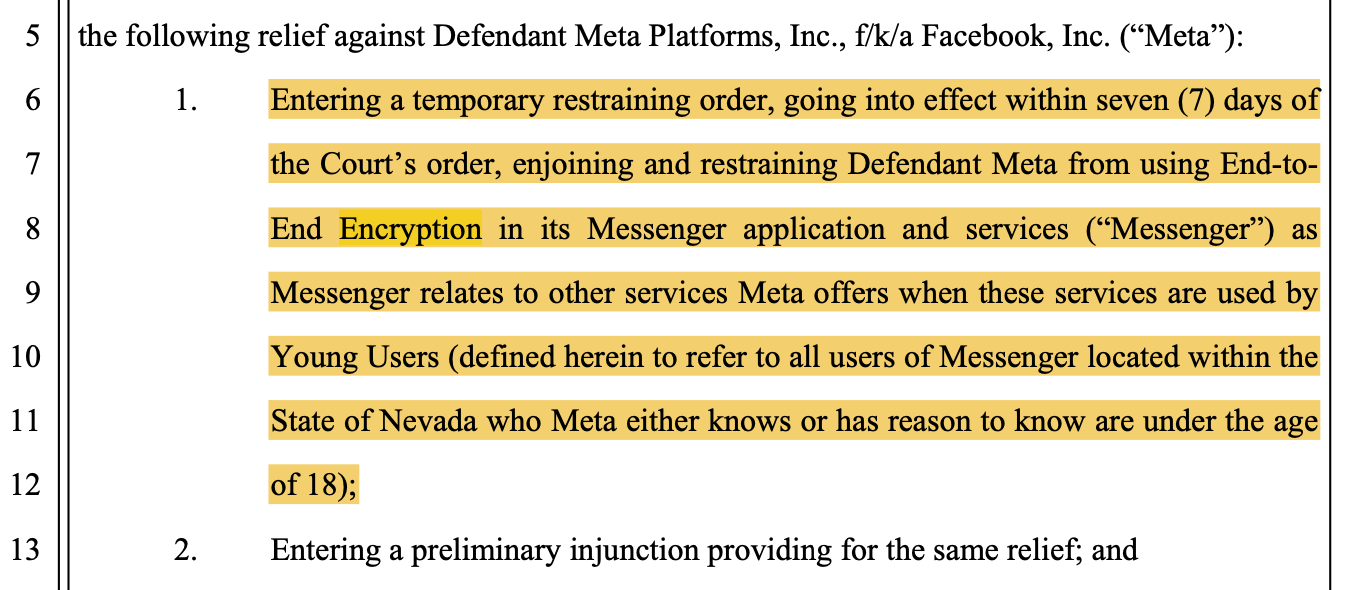
This is beyond crazy: the State of Nevada has engaged a bunch of lawyers on a no-win-no-fee basis to go sue all the major teenage platforms on a variety of grounds, each tuned to the platform concerned, most of which are variations on a theme of “kids can talk to each other.”
BUT OF COURSE, end-to-end encryption (along with, e.g., disappearing messages & other forms of attack-surface minimisation) are — for purposes of Law Enforcement and how they perceive Teenagers — treated as being a unique problem.
Hence this brief (found via Riana Pfefferkorn) — which is laden with misrepresentation:
https://drive.google.com/file/d/1qq9ZkJaLHEsEiMg2rSd2hqI1SPSQb0Y8/view?pli=
Among other stakeholders, the National Center of Sexual Exploitation has blasted Meta’s decision to use E2EE on Messenger, stating that “[b]y implementing end-to-end encryption, Meta has guaranteed that child sexual abuse cannot be investigated on its platforms”
…which ignores metadata analysis and reporting infrastructure…
Meta has effectively thrown up its hands, saying that child sexual abuse is not its problem,” said Dawn Hawkins, CEO, National Center on Sexual Exploitation. Id. at ¶ 204.
…except they haven’t, in several ways; but the manner which pumps up meaningless statistics that bolster NCMEC funding, will be reduced.
Encryption on Messenger Enables Predators to Stalk Young Users with Impunity
No. Just, no; but it gets worse because apparently giving everyone privacy is the same as abetting child predators:
the State alleges that Meta “willfully committed . . . deceptive trade practices by violating one or more laws relating to the sale or lease of goods or services” in violation of NRS § 598.0923(1)(c). Compl. ¶ 473. Nevada law states that “[a] person shall not willfully use or attempt to use encryption, directly or indirectly, to: (a) Commit, facilitate, further or promote any criminal offense; (b) Aid, assist or encourage another person to commit any criminal offense; (c) Conceal the commission of any criminal offense; (d) Conceal or protect the identity of a person who has committed any criminal offense; or (e) Delay, hinder or obstruct the administration of the law.” NRS § 205.486 (“Unlawful use of encryption”) […] This amounts to both direct and indirect aiding and abetting of child predators, via the use of E2EE, in violation of NRS § 205.486(1)(a)-(d).
…which (generic provision of privacy) is for some reason a problem here, but not in the HTTPS protocol which protects people who access the Nevada AG’s website.
Riana characterises this as:
… the biggest attack on encryption in the United States since 2016.
https://mastodon.lawprofs.org/@riana/111982818797702511
…and yes, it needs to be beaten down, not least because it endangers ALL online privacy on the grounds that it might be used by a bad person to do a bad thing.
I wonder if they will apply the same logic to guns? Or cars?

Leave a Reply