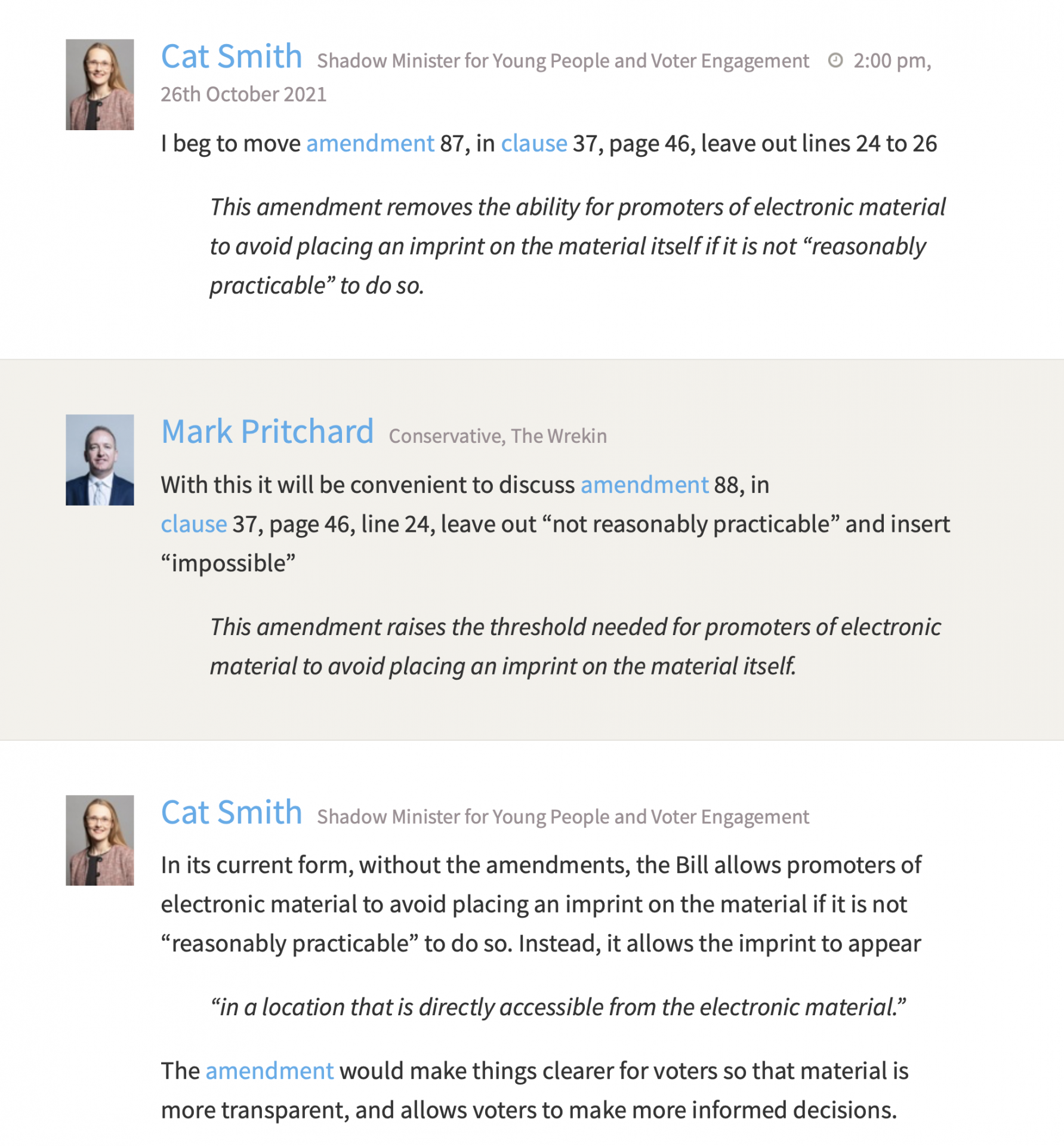
I beg to move amendment 87, in clause 37, page 46, leave out lines 24 to 26
This amendment removes the ability for promoters of electronic material to avoid placing an imprint on the material itself if it is not “reasonably practicable” to do so.
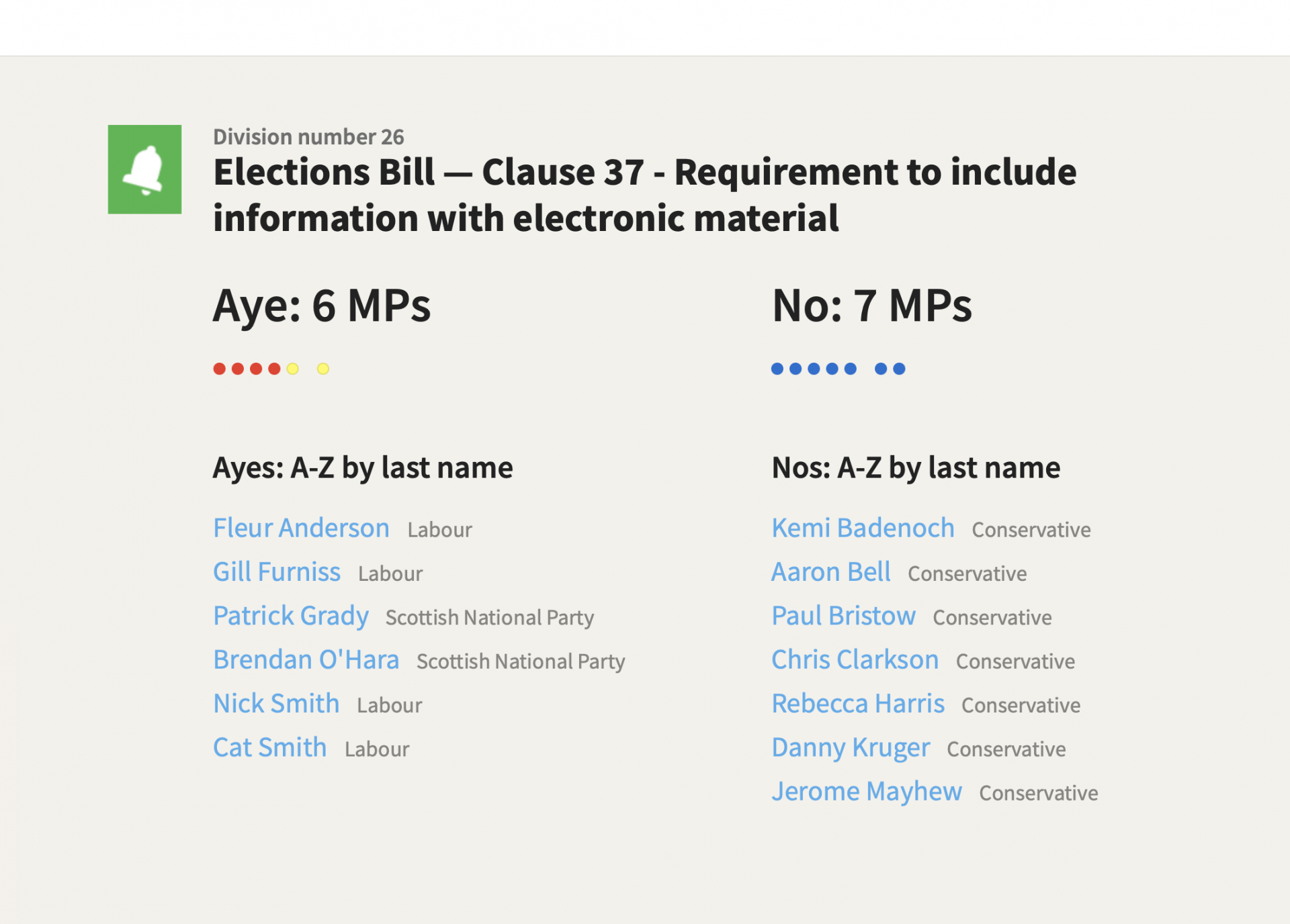
This is faintly worrying, but I have not yet sussed out the whole story. As I am reading this, the “loophole” proposed to be “closed” by the SNP member’s (failed) amendment, was that “election material” would need to be “imprinted” (marked as being published by a given publisher / campaign) as part of the video, audio, PDF, or whatnot.
“But Alec —”, I hear people begin, “— democracy is under threat from Mark Twittertocker, and this is just what happens in the offline world where campaign leaflets must be stamped with whom they are being distributed upon behalf of…”
And yeah, whatever, okay, I know — not least, my father was a County Councillor and I’ve seen plenty of election leaflets in my time — but read this bit, too:
All political parties in Scotland took advantage of the loophole in May, placing an imprint on their home page and not necessarily on the material that was being promoted. This provision does not provide any security against sharing, downloading and re-promoting, where many voters will see material second or third hand as organic content as it spreads over social media … I have certainly seen concerns … that there is a risk that the imprint may be lost or removed, deliberately or accidentally, when the material is shared. A significant amount of sharing happens off the platform, as users download videos before resharing them on messaging apps that are often encrypted. The imprint is then, of course, disconnected from the content. This is a huge loophole; it could be the equivalent of attaching an offline political ad’s imprint using a paperclip. The first recipient would then clearly and inconspicuously remove it before showing anyone else. It is essential that the imprint be embedded so that it is always connected to the political advertisement. I urge the Government to close the loophole and make it clear that the video, image or online campaign materials must contain a clear imprint within the material, as is common practice with many political video advertisements in countries such as the United States.
…which is awfully similar in form and intent to illiberal disturbing calls in India for WhatsApp messages to be attributable to their original sender.
Anyone who has visited a website that does or used to host user-uploaded adult content knows that watermarks, pre-roll and post-roll titles, and all manner of other “imprints” are cropped from material, which is further remixed and reshared all the time.
My usual metric for looking at dual-use weapons — in this case: mandatory attribution of speech — is to look at the intent, and I agree that this intent is relatively benign. But at some point the defenders of democracy who call for this feature are going to try and up their game, and this worries me, because I am not sure what they are going to call for, next time.
Given yet another false choice between “mandatory imprints/attribution of speech” versus “unattributable election misinformation”, I will speak in favour of the latter even if it yields the same sort of public rumourmill that brought us Brexit.
All data is speech. Mandatory attribution of data/speech is the same as the end of online anonymity. We should take care re: when we actually call for that, especially those of us who work so hard to protect it.

Leave a Reply