-
Two posts on reverse-engineering #PokemonGo
Via Alex Butcher. If I weren’t already so busy I would be using this as an excuse to brush up my advanced Lua… https://www.romainthomas.fr/post/21-11-pgsharp-analysis/ https://www.romainthomas.fr/post/21-07-pokemongo-anti-frida-jailbreak-bypass/
-
Michigan poised to ban most state workers’ use of encrypted messaging | I’ve absolutely no problem with an employer (e.g. The Government) banning employees from conducting work over E2EE …
… not least, it provides business opportunities for all manner of small per-nation escrowed-access startup messengers which can leak sensitive content all over the Web once they are inevitably hacked. The important thing is that the public-at-large need not suffer the same fate: The Michigan State Senate voted unanimously on Tuesday to block state workers…
-
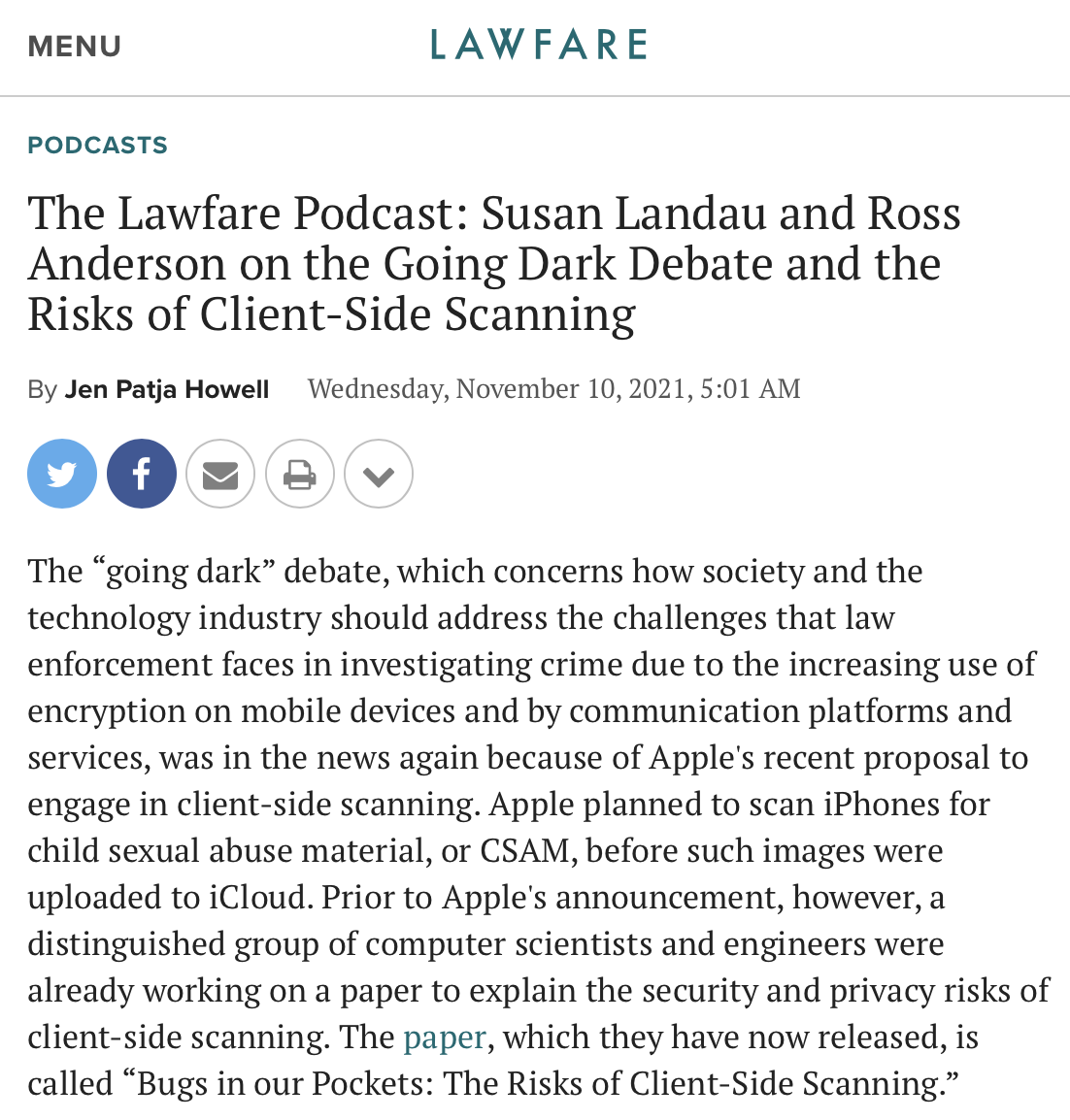
The Lawfare Podcast: Susan Landau & Ross Anderson on the Going Dark Debate & the Risks of Client-Side Scanning – Lawfare | #SusanLandau & @rossjanderson on the Apple/CSAM, via @webdevlaw; #MUSTLISTEN
An impressive, and important podcast — well worth the investment of an hour to hear two Professors (and co-authors of “Bugs in Our Pockets”) analysing the Apple CSAM Surveillance proposal: To talk about this most recent development in the going dark debate, Stephanie Pell sat down with two of the paper’s authors: Susan Landau, Bridge…
-
Using SOUNDEX / Homophones / Misspellyngs & Scope Expansions to bypass Social Media Censorship and Blocks
I honestly have no idea why a basic search for “Kyle Rittenhouse” on Facebook should bring up zero results; it might be an intentional attempt to limit access to abusive UGC, or it might be that the keywords have become associated with abusive content somewhere inside Facebook’s automated abuse-blocking systems, or it might be a…
-
TikTok reveals details of how its coveted algorithm works – Axios
The beleaguered app describes the inner workings of its video-selection code. Source: TikTok reveals details of how its coveted algorithm works – Axios
-
Why TikTok made its user so obsessive? The AI Algorithm that got you hooked. | by Catherine Wang | Towards Data Science
Tick Tok is taking the world by storm. The short video app was downloaded 2 billion times, so what is the magic behind it ? Source: Why TikTok made its user so obsessive? The AI Algorithm that got you hooked. | by Catherine Wang | Towards Data Science
-
“Comprehensive Guide to build Recommendation Engine from scratch” — I kinda wish that any pundit writing about (e.g. newsfeed) “algorithms” was required to build one like this, first.
This is a comprehensive guide to building recommendation engines from scratch in Python. Learn to build a recommendation engine using matrix factorization. Source: Comprehensive Guide to build Recommendation Engine from scratch
-
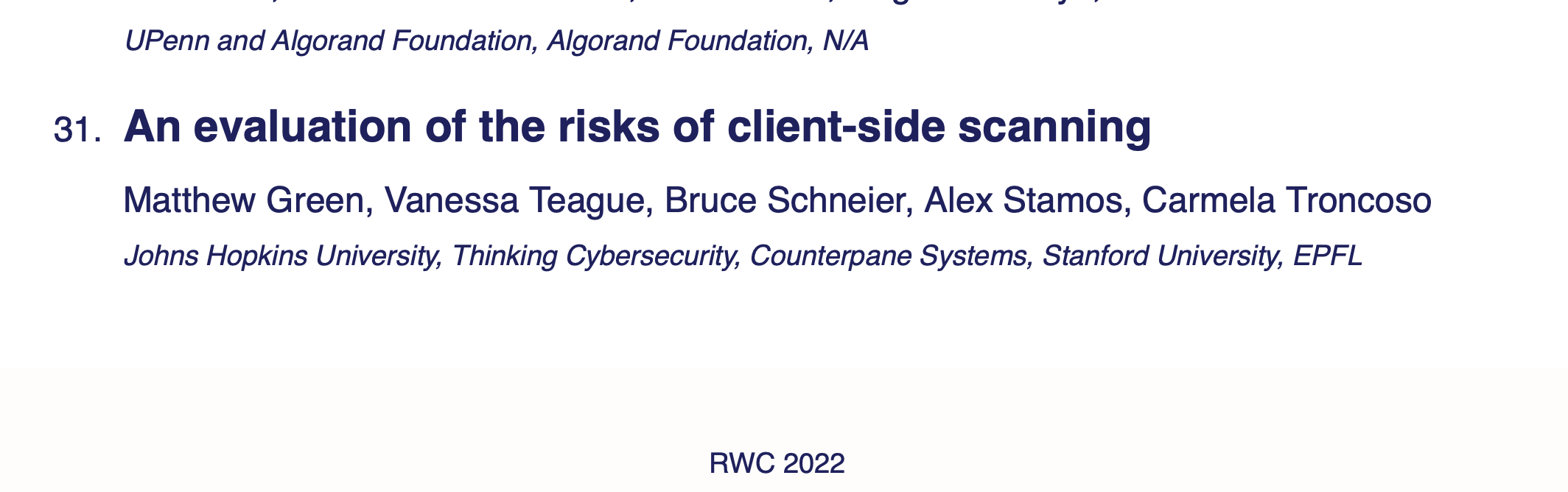
#RealWorldCryptography 2022: Accepted Talk Proposals
This: https://rwc.iacr.org/2022/acceptedpapers.php Notably: 31. An evaluation of the risks of client-side scanningMatthew Green, Vanessa Teague, Bruce Schneier, Alex Stamos, Carmela Troncoso Johns Hopkins University, Thinking Cybersecurity, Counterpane Systems, Stanford University, EPFL
-
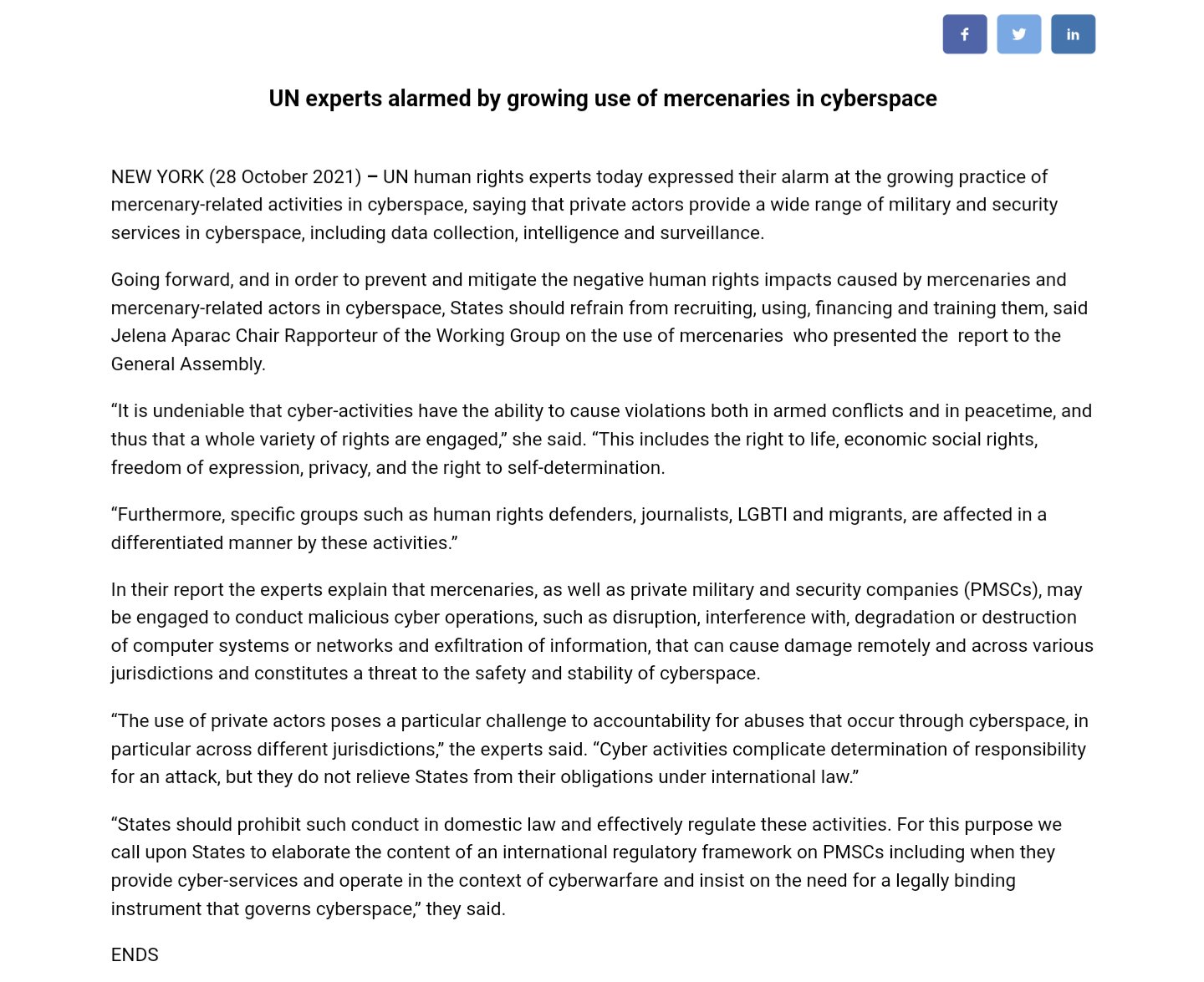
Discussion with @runasand: “One Nation’s Cybermercinaries are another’s Ethical Hackers”, per the @UN
Runa: Good point from @UN human rights experts on the use of mercenaries in cyberspace: “The use of private actors poses a particular challenge to accountability for abuses that occur through cyberspace, in particular across different jurisdictions.” https://www.ohchr.org/SP/NewsEvents/Pages/DisplayNews.aspx?NewsID=27729&LangID=E Alec: White Hat Hackers: “Do they mean [me]?” R: No. A: Hard disagree. The fallacy of cyber…
-
Something to Watch (or Listen To) @jonronson introduces his new Podcast “Things Fell Apart” on #BBCR4today #r4today (Nov 8th)
A friend pointed me at the Today Programme (start at 2h24m19s) https://www.bbc.co.uk/sounds/play/m0011cg5 …wherein Jon Ronson spends several minutes arguing that more people, with more distinct voices and life experiences, should spend more time talking to and with each other, and to more diverse audiences, without the threats of (e.g.) “deplatforming” … and then somehow swings…
-
If you’re looking for a list of things to be angry or worried about, regarding “Internet Security” vs State attempts to inveigle their way into owning it, @JoeBeOne has you covered…
Unrolled (click through above for links) Out today: Internet Impact Briefs – A New Way To Assess How Policies May Affect The Internet (and How You Can Create One) @ndunleavy @carlgahnberg @internetsociety In addition to a guide on how to conduct an Internet impact assessment ( https://www.internetsociety.org/resources/doc/2021/how-to-conduct-an-internet-impact-brief/ ), we are publishing five impact briefs today……