type o negative

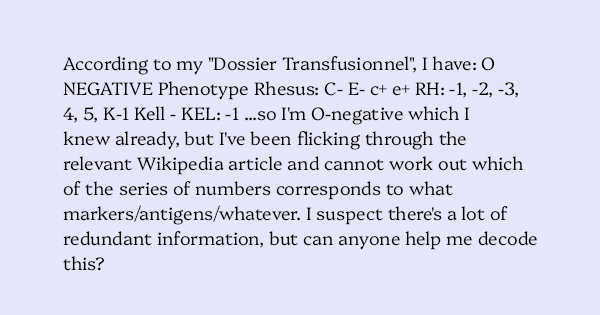
According to my “Dossier Transfusionnel”, I have:

O NEGATIVE
Phenotype Rhesus: C- E- c+ e+
RH: -1, -2, -3, 4, 5, K-1
Kell –
KEL: -1

…so I’m O-negative which I knew already, but I’ve been flicking through the relevant Wikipedia article and cannot work out which of the series of numbers corresponds to what markers/antigens/whatever.

I suspect there’s a lot of redundant information, but can anyone help me decode this?
Comments

3 responses to “type o negative”

  1. Melodie Neal
    re: type o negative

    Hi Alec

    Actually the information is quite specific, and the best reference is probably the Serum, Cells and Rare Fluid Exchange (no, I am not kidding: jove.prohosting.com/~scarfex/blood/groups.html). O Neg you understand: you are what used to be called a universal donor, before our understanding of blood got more detailed. Phenotype Rhesus describes the expression of the rhesus antigens (these are transmembrane proteins) in your system. There are three series of RH antigens: D, Cc and Ee. D is really only interesting if you are pregnant, so the blood testing folks may not have checked for it in your case, but if it is completely absent if puts you in the smallish section of the population that is RH negative.

    The CDE encoding is known as the Fisher System, and I think the next line is also Rhesus info, but differently coded. The last bit covers Kell antigens, and you are Kell 1 negative. Sorry, I’m a bit rusty on this, too many years out of the library.

    The medical professions tries to get the closest match they can for a transfusion, because most patients will develop antibodies to any mismatched components they get. This can then become a problem if they get another transfusion at a later date, and get more of the mismatched components. This will set of a reaction, and the previously developed antibodies will attack the newly transfused cells. Since you are generally already in a bad spot when you get a transfusion, a bad reaction is something you really don’t need.

    rgds

    Melodie

  2. alecm
    re: type o negative

    Hi Melodie,

    Well that was a surprise! I’ll delve into it a bit more if I can, but reassuringly both transfusion documents (from which I infer I received 2 pints/whatever) match exactly in donor and recipient specifications, so I suppose I haven’t much to worry about.

    If I understand “RH: -1, -2, -3, 4, 5, K-1” correctly, assuming K means “Kell”, I presume I am lacking 4 things and have 2 present; if the latter are c/e, that presumably means I am missing D as well, making me rhesus negative.

    Though I have no idea what this actually means. To me, rhesus is a small monkey.

    I am not a small monkey. 🙂

  3. bartb
    rhesus & small monkeys

    “The fine details of the Rh system tell a very complicated story, but for our purposes here we can assume that there are two alleles, the + (plus) allele and the – (minus) allele. Like the ABO system, the Rh locus codes for an antigen that resides on the surface of the red blood cell. It was discovered in 1940 that blood of individuals with at least one + reacted to an antiserum developed from Rhesus monkeys, hence the name of the locus. Individuals homozygous for the – allele did not react. The + allele was considered dominant because the heterozygote +- reacted to the antiserum.”

    so the rhesus factor was discovered using small monkeys, but doesn’t imply you’re one…

    (found on psych.colorado.edu/~carey/hgss/hgssapplets/mendelian/rhmatings/Rhbloodgroup.html, a good simple read seems to be available on http://www.bbc.co.uk/dna/h2g2/A2116621 )

Leave a Reply

Your email address will not be published. Required fields are marked *