Spindle Mathematics

I just gutted a disk drive, and some statistics are as follows:

It’s a Seagate ST336607LC – a 36Gb disk – containing a single platter, with (obviously) two faces, top and bottom. There is a hole in the middle of the platter, where the motor drive / axle resides.

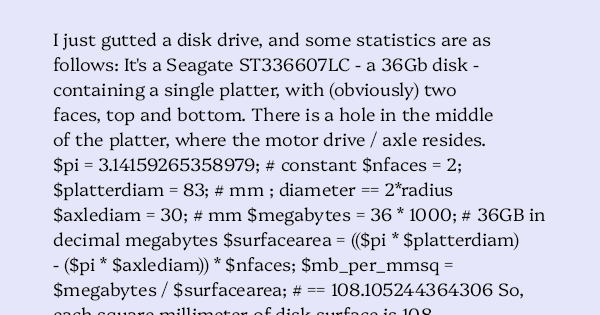
$pi = 3.14159265358979; # constant
$nfaces = 2;
$platterdiam = 83; # mm ; diameter == 2*radius
$axlediam = 30; # mm
$megabytes = 36 * 1000; # 36GB in decimal megabytes
$surfacearea = (($pi * $platterdiam) – ($pi * $axlediam)) * $nfaces;
$mb_per_mmsq = $megabytes / $surfacearea; # == 108.105244364306

So, each square millimeter of disk surface is 108 megabytes, and a 1mmsq section through the disk would provide two faces, or 216Mb.

Interesting – and disks are much bigger now, of course.
Comments

7 responses to “Spindle Mathematics”

  1. Watching Them, Watching Us
    re: Spindle Mathematics

    Shouldn’t you be calculating the angle of the sector which passes under each read / write head per unit time ?

    The data storage density is not the same on the inner tracks near the spindle, as on the outer tracks, where the same amount of data per second is spread out over a larger surface area – that is why tracks are divided into sectors.

    There used to be variable speed floppy diskette drives available on (museum piece) Apple II and ACT Sirius (pre IBM compatible MSDOS), and possibly DEC Rainbow, personal computers which packed more data into the outer tracks by slowing down the spindle speed as the read / write head stepper motor moved across the tracks. You could play “tunes” by accessing different tracks as characteristic “musical” whines and hums.

  2. Stephen Usher
    re: Spindle Mathematics

    Actually, CD/DVD drives use the same variable speed technique, as did the original 800KB Mac floppy drives.

  3. alecm
    re: Spindle Mathematics

    >Shouldn’t you be calculating the angle of the sector which passes under each read / write head per unit time ?

    Depends what i am trying to achieve.

    In this instance it is a ballpark figure, not a data model.

  4. Weeze
    re: Spindle Mathematics

    It must be the genes . . .

    I periodically find myself compelled to calculate the relative cost of a hard drive based on the fact that when I was selling PCs in 1984 a 10MB hard drive was $895, and that now an 80GB drive can be had for $60.

    Right now, I think that in 2006 terms, that 10MB drive should cost less that one cent, and in 1984 terms, the 80GB drive should cost slightly more than seven million dollars . . .

  5. alecm
    re: Spindle Mathematics

    (80 * 1000 * 895 / 10) == (7,160,000) — so that’s 7.16 million, not counting for inflation, though…

  6. Weeze
    re: Spindle Mathematics

    So, how much is it if you do adjust for inflation????

  7. alecm
    re: Spindle Mathematics

    $13,454,740 in the year 2005 has the same “purchase power” as $7,160,000 in the year 1984 — according to eh.net/hmit/ppowerusd/

Leave a Reply

Your email address will not be published. Required fields are marked *