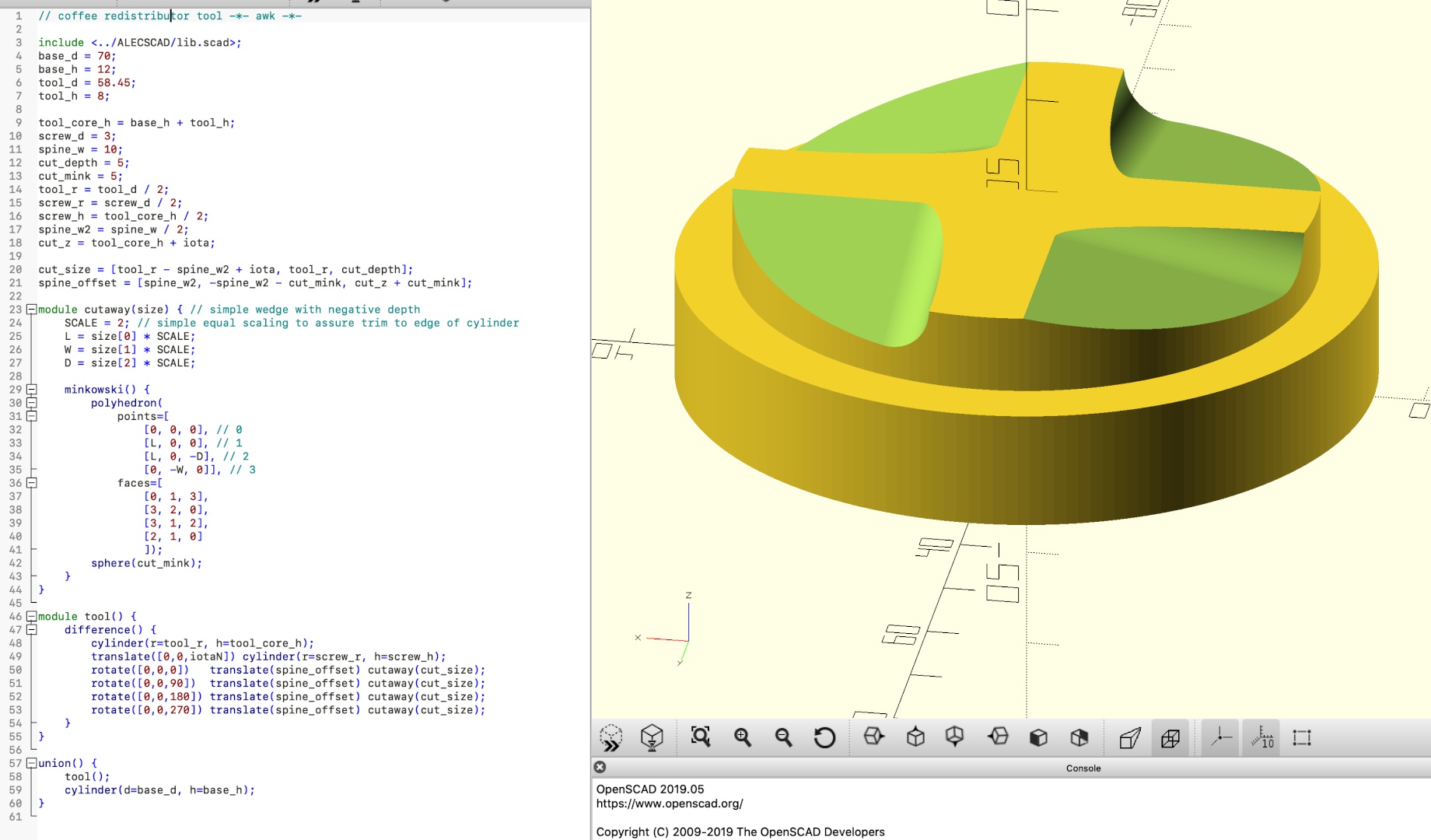
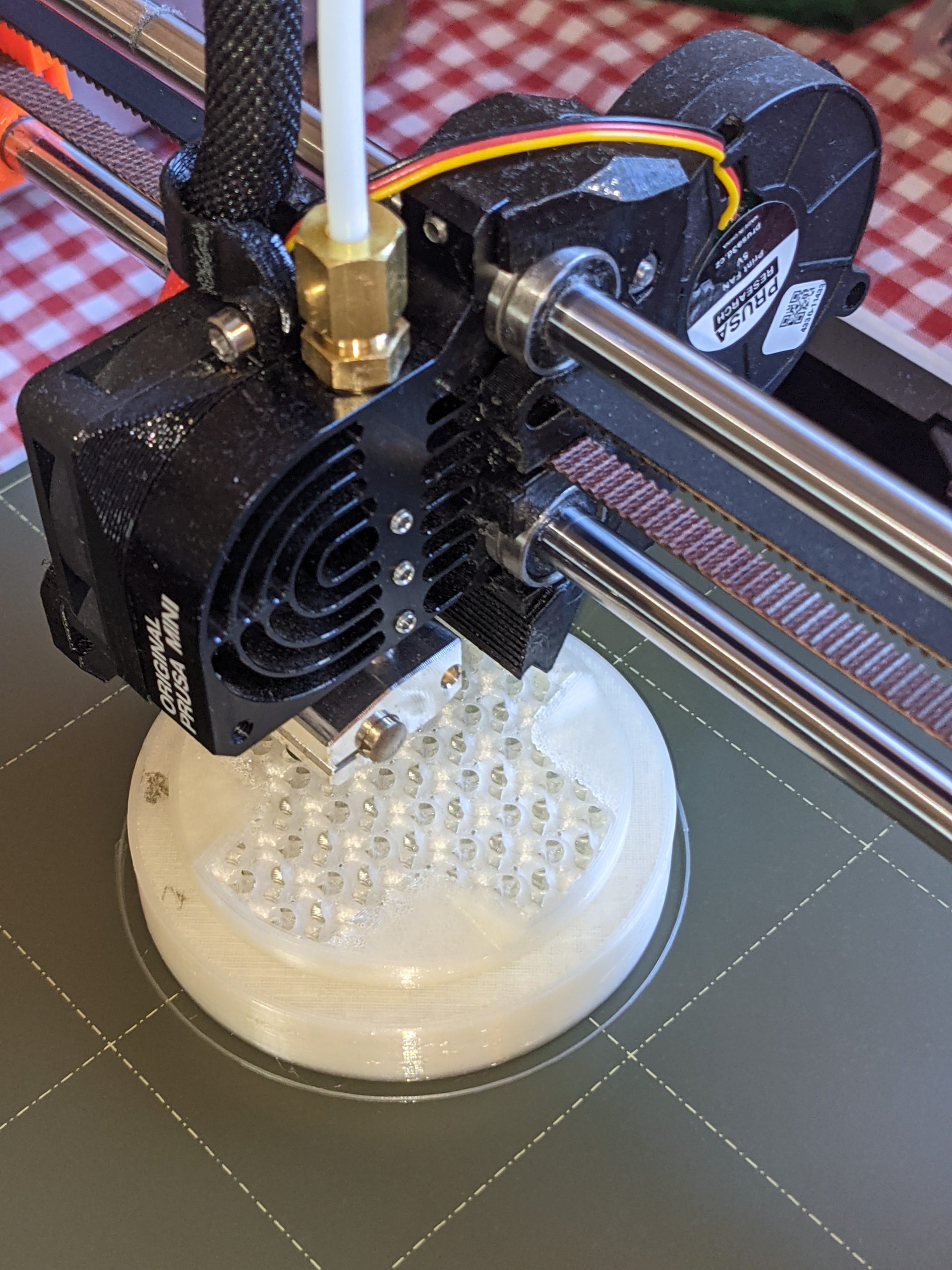
It’s been a learning exercise in OpenSCAD, and I’m not sure how it will perform, but once it’s tested and refined a bit, I’ll be publishing everything. The printer is currently doing the base, I have it set up to print and it’ll take about 5 hours.
Update
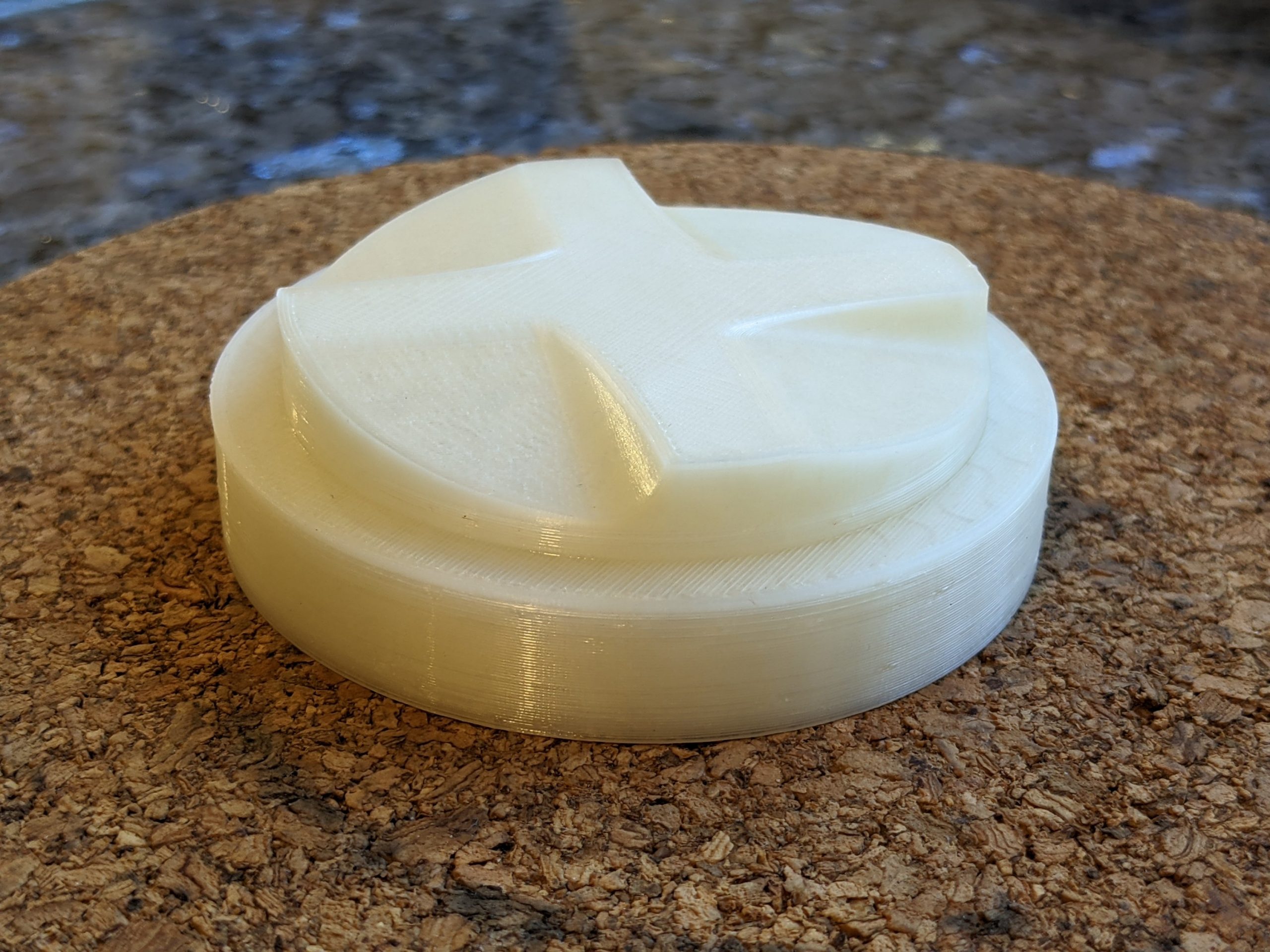
The distributor printed nicely – ColorFabb natural PLA-PHA, excepting for some smears of black Prusament, due to an unclean nozzle being used for “ironing” the top surfaces.
This is meant as a “prototype” but it’s a good prototype. I’ll see how it lasts.
I sliced it in PrusaSlicer it with a 0.05mm layer height and variable-height mode (so that simple layers are printed at 0.25mm or similar) and 15% gyroid infill, and slightly-reduced base layers to save both time and PLA.
It’s nicely smooth – not perfectly so, but you can’t expect that with a filament printer – and it makes a snug fit for the VST basket.
Previously I have used a very simple distributor from Thingiverse for trying to level the grind, but it was the wrong size for my VST basket and I wanted to be able to hack the tool, hence why I am reinventing it all from scratch.
So far I’ve tried the distributor on just one espresso shot: 20g of Coffee Gems’ Humble Juan on a fine espresso grind in my Baratza, after WDT and tapping to roughly distribute. It was nice to be tamping a properly level surface. I then spritzed the tamped puck, RDT-style, to do a kind of pre-pre-infusion. The resulting espresso was good, evenly extracted and with no signs of channeling – which pleases me because for some reason I’ve experienced a lot of channeling recently.
The tool itself retained 0.2g of beans on the tool surface due to the slight roughness of the print. To address this I have coated all the distributor tool surfaces with a thin layer of paraffin wax, which I’ve then buffed-off with hot water and a cloth. This should help waterproof the PLA and (I hope) make it less attractive to coffee grind “stickation”. I’ll report-back regarding how this goes.
Eventually the goal will be to built a variable-depth solution using a screw thread, but at the moment the tool depth is a fixed parameter.

Leave a Reply